Struggling to fall asleep? Discover how sleep meditation calms your mind and body, plus a simple routine to try tonight. Start sleeping better now.
.webp)
Quick Summary: Sleep meditation is a set of guided relaxation techniques—breathwork, body scans, and visualization—that calm the nervous system so the mind can stop racing and the body can wind down. It works by shifting the body out of a stress response and into a rest state, which makes falling and staying asleep easier without medication. Most people notice benefits within a few nights of consistent practice, and pairing it with a calming visual or audio experience tends to make the habit stick.
Lying awake at 1 a.m., replaying tomorrow's to-do list, is one of the most universal frustrations there is. The mind won't quiet down, the body feels tense, and the harder you try to force sleep, the further away it seems to drift. That's exactly the problem sleep meditation was built to solve.
Unlike sleeping pills or melatonin gummies, sleep meditation doesn't sedate the body chemically. It works with the nervous system rather than against it, guiding attention away from anxious thought loops and toward something slower and more physical—breath, sensation, imagery. Done consistently, it can shorten the time it takes to fall asleep and reduce those middle-of-the-night wake-ups that leave people groggy the next morning.
Sleep meditation is a guided practice designed specifically to prepare the mind and body for rest. It usually combines slow breathing, progressive muscle relaxation, and some form of gentle narration or visualization that pulls attention away from stress and toward calm, repetitive sensations.
It's different from general mindfulness meditation, which is often practiced sitting up during the day with the goal of staying alert and present. Sleep meditation has the opposite goal: it's meant to lower alertness gradually until sleep takes over naturally. Many sessions are recorded with a soft, unhurried voice, and some pair narration with ambient sound or visual elements to deepen the relaxation response.
When stress hormones like cortisol are elevated, the brain stays on high alert—scanning for threats even when there's nothing to worry about. That's the biological reason racing thoughts show up right when you want to switch off. Sleep meditation interrupts that pattern by activating the parasympathetic nervous system, the body's built-in "rest and digest" mode.
Slow, extended exhales send a signal to the brain that it's safe to relax. Heart rate drops, muscles loosen, and the mental chatter that felt so urgent a few minutes earlier starts to fade into the background. This shift doesn't happen instantly—it's a gradual process, which is why most sleep meditations run anywhere from ten to thirty minutes.
Not every technique works the same way for every person. Some people respond best to physical relaxation cues, others need something for the mind to focus on so it stops wandering. Here's a breakdown of the most common approaches.
This is probably the most familiar style—think of a soothing voice describing a walk through a quiet meadow or a slow drift down a river. The goal isn't really the scenery itself; it's giving the mind something gentle and non-threatening to focus on so it can't spiral into tomorrow's stressors.
A body scan works from the feet upward (or the reverse), consciously relaxing each muscle group in turn. It's especially useful for people whose stress shows up physically—clenched jaws, tight shoulders, restless legs—rather than purely as anxious thoughts.
Breathing techniques like 4-7-8 breathing (inhale for four counts, hold for seven, exhale for eight) directly slow the heart rate. It's simple enough to do without any guidance at all, though pairing it with a narrated session tends to keep people from getting distracted halfway through.
For people who find it hard to sit still with eyes closed, a visual meditation experience adds a gentle point of focus—slow-moving light patterns or soft color transitions paired with ambient audio. This passive engagement can make it easier to stay with the practice long enough for it to actually work. Apps built around this format, including visual sleep meditation sessions, are designed around that exact idea.

Sleep meditation can help create a calmer transition between a busy day and bedtime. Mesmerize combines sleep stories, guided sessions, music, soundscapes, and slow-moving visuals in one customizable app.
Mesmerize includes:
👉 Download Mesmerize for iPhone or for Android to try visual meditation for free.
How does meditation stack up against the other tools people reach for at night? Each has trade-offs worth knowing before picking one.
The short answer? Meditation is slower to kick in than a pill, but it doesn't come with the tolerance or dependency concerns that some sleep aids carry. It also builds a skill—the more it's practiced, the faster the body learns to recognize the cues and respond.
There's no need for anything elaborate. A basic fifteen-minute session, broken into three phases, covers most of what matters:
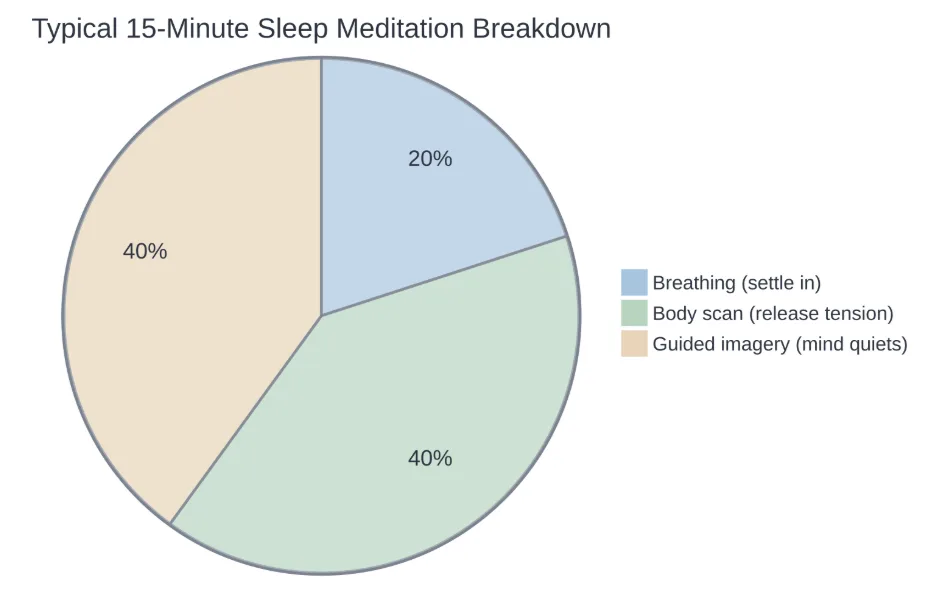
Consistency matters more than perfection here. Doing this most nights, even imperfectly, tends to produce better results than one flawless session followed by two weeks off.
A few habits quietly undermine sleep meditation before it gets a real chance to work:
Sleep meditation works best as part of a broader wind-down sequence rather than a standalone fix squeezed in right before lights out.
Over time, this sequence becomes a cue in itself—the brain starts associating the routine with sleep, so the meditation works faster and faster. Those curious about the evidence behind this kind of relaxation response can look into the research on visual meditation and its effects on sleep for a closer look at what's actually being measured.
Some people do fine with a plain audio track and closed eyes. Others need more structure—something to actually look at so the mind has less room to wander. A customizable, audio-visual approach tends to suit people who've tried standard guided audio and found their attention kept slipping. Sessions built around anxiety-focused relaxation techniques can also help when racing thoughts, not just physical restlessness, are the main barrier to sleep. And for anyone who meditates for reasons beyond sleep, similar techniques adapted for daytime focus and concentration use the same underlying principles in a different context.
Sleep meditation isn't a magic switch, but it is one of the more reliable, side-effect-free ways to help the body do what it's already wired to do: rest. The key is consistency—showing up most nights, choosing a format that actually holds your attention, and giving the nervous system time to learn the pattern.
For anyone ready to build this into a real nightly habit rather than a one-off experiment, exploring a structured meditation plan or simply downloading a guided visual meditation app is a practical next step. More on the techniques covered here—and others worth trying—can be found on the meditation and wellness blog.
I canceled my subscription with Headspace and I now pay for Mesmerize instead. I was hooked after the free trial! I love how customizable the sounds, meditations, and visuals are! Using this app has honestly become my favorite part of my day! ☺️ It helps me relax, meditate, visualize, sleep, and it does wonders for my anxiety/phobia/ocd tendencies. Thank you Mesmerize for giving us this amazing mental health tool! I told my therapist about this app and have been telling all my friends too. It’s just so helpful!
This is the second or third app in the mindfulness and meditation realm, and it’s the most scientific approach I have found. I have found these combinations of open monitoring, and focused attention meditation techniques are the most viable for those suffering from more severe forms of sleep, pain, and anxiety dysfunction one may be suffering from. Many of these approaches are used by professionals in a cognitive behavioral therapy setting. A truly complete approach in mindfulness and meditation.
I suffer from clinical depression and sometimes I get into a bad headspace but this app has really helped me whenever I’m in a bad mood I turn on the app listen to some person taking about breathing and look at cool figures on my phone and it makes me feel so much better I would highly recommend this app it’s worth the money
It didn’t take but five minutes of using this app to buy a yearly subscription. Worth it on so many levels. Easy to manipulate to what I like. Massive library of music, videos, etc.
Clear your mind and relax with a unique audio visual meditation experience.


.jpeg)