Discover what spiritual meditation really means, how it works, and how to start today. Explore techniques, benefits, and tips to deepen your practice now.
.webp)
Quick Summary: Spiritual meditation is the practice of quieting the mind to connect with something larger than the individual self—whether that's called God, the Universe, a higher power, or simply inner truth. Unlike stress-focused mindfulness, it centers on meaning, connection, and transcendence rather than just calm. Most people build a practice through breathwork, mantra, prayer, or guided sessions, and benefits show up as reduced anxiety, sharper focus, and a stronger sense of purpose over weeks of consistent practice.
Somewhere between a quiet room and a racing mind, a lot of people start asking bigger questions. Not "how do I relax," but "what am I actually part of?" That's usually the moment spiritual meditation enters the picture.
It's not a new invention. Spiritual meditation practices trace back thousands of years across nearly every major religious and wisdom tradition. But the way people practice it today looks different—less robes and temples, more apps, guided audio, and fifteen-minute sessions squeezed between meetings. This guide breaks down what spiritual meditation actually is, how it differs from the mindfulness everyone talks about, and how to actually start a practice that sticks.
At its core, spiritual meditation is a meditation practice undertaken with the intention of connecting to something beyond the individual self—a higher power, the Universe, God, or one's deepest inner nature. It's less about managing a busy schedule and more about exploring meaning, purpose, and connection.
That distinction matters. Someone meditating to lower cortisol before a big presentation is doing something valuable, but it's not quite the same activity as someone sitting in silence trying to feel connected to a divine presence or to all living things. Both use stillness and breath. The intention behind them is what separates them.
Spiritual meditation shows up in Christian contemplative prayer, Buddhist loving-kindness practice, Sufi whirling, Hindu japa mantra repetition, Kabbalistic visualization, and plenty of secular practices built around gratitude, oneness, or awe. The forms vary wildly. The underlying aim—transcending the narrow sense of "me"—tends to stay consistent.
People often use these terms interchangeably, and that causes confusion. Here's a side-by-side look at where they overlap and where they split.
None of this means the two can't overlap. A lot of practitioners blend them—starting with mindful breathing to settle the nervous system, then moving into something more contemplative. For a short structured entry point into that first stage, a quick daily meditation session can be a useful warm-up before deeper spiritual work.
The mechanics are simpler than they sound. Most spiritual meditation follows a similar arc: settle the body, quiet the mental noise, then hold attention on something that represents connection—a word, an image, a breath, a presence.
What happens physiologically isn't mysterious—slower breathing and sustained attention shift the nervous system toward a parasympathetic, rest-and-digest state. What happens experientially is harder to pin down, since "connection" means something different to everyone. Some describe warmth or expansiveness. Others describe nothing dramatic at all, just a quiet sense of being okay. Both are normal.

Spiritual meditation often uses stillness, focused attention, breathing, or reflection to create space for a deeper practice. Mesmerize can provide a calm backdrop with immersive visuals, guided sessions, soundscapes, and customizable breathing patterns.
Mesmerize includes:
👉 Download Mesmerize for iPhone or for Android to try visual meditation for free.
.webp)
There's no single "correct" method. A few of the more widely practiced approaches:
Guided audio has made all of these far more approachable. Instead of guessing at technique, a voice walks the listener through each stage—which is part of why guided spiritual meditation tracks have become so popular on streaming platforms in recent years.
Research on meditation broadly is fairly robust; research specifically isolating the "spiritual" intention is thinner, so some of what follows is best understood as commonly reported experience rather than settled clinical fact.
People exploring the physiological side of contemplative and visual practices can look at the research behind visual meditation techniques, which covers how guided visual and audio cues influence relaxation states.
Starting doesn't require a teacher, a temple, or a specific belief system. It requires a few honest decisions about what connection means personally, and a willingness to sit with discomfort for a few minutes at a time.
Five-step decision flow for building a first spiritual meditation habit.
For anyone building this habit alongside a broader wellness routine, a structured meditation plan can help remove the friction of figuring out what to do each day, pairing visual and audio cues with session length that fits actual schedules rather than idealized ones.
Almost everyone hits the same three walls. The mind wanders constantly—that's not failure, that's what minds do. Sessions feel emotionally flat some days and overwhelming on others, which is normal for anything touching on meaning and identity. And skepticism creeps in: is this actually doing anything, or just sitting quietly?
The honest answer is that spiritual meditation rewards patience more than perfection. Distraction isn't a sign to quit; it's the actual exercise—noticing, and gently returning. Emotional swings tend to smooth out over weeks, not single sessions. And skepticism is fine to hold onto. Plenty of long-term practitioners started as skeptics and let the experience, rather than belief, do the convincing.
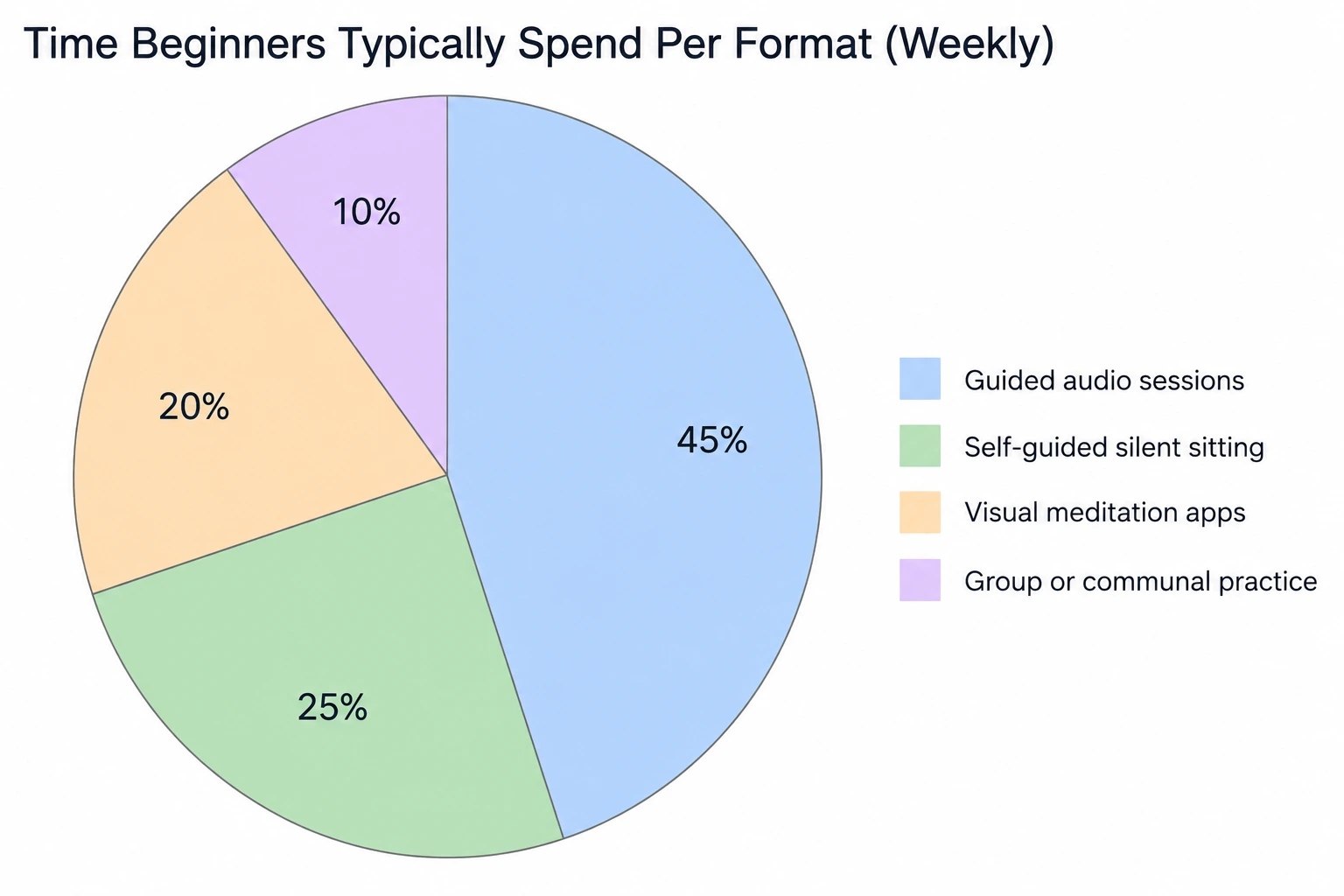
Guided sessions—whether audio, app-based, or in a group setting—work well for beginners because they remove decision fatigue. There's no need to figure out pacing, imagery, or when to end. Self-guided silent practice, on the other hand, tends to appeal more to experienced practitioners who've already internalized a rhythm and want fewer external cues.
A reasonable approach: start guided, and gradually loosen the training wheels as the practice becomes familiar. Visual meditation formats—pairing gentle imagery with audio—can bridge that gap nicely, giving enough structure to stay focused without narrating every second. Those interested in trying that format can download a visual meditation app to test a session firsthand, or browse current plans and pricing before committing.
Rough weekly time split beginners report across common meditation formats.
Spiritual meditation isn't about achieving some dramatic mystical breakthrough on day one. It's a slow, cumulative practice of returning attention to something bigger than the day's to-do list. Some sessions will feel profound. Most will feel ordinary. Both count.
The best way to find out what spiritual meditation offers is to actually try it—starting small, staying consistent, and paying attention to what shifts over a few weeks rather than a few minutes. For a low-pressure way to begin, explore more meditation guides and wellness articles or start with a short guided session designed for daily use.
I canceled my subscription with Headspace and I now pay for Mesmerize instead. I was hooked after the free trial! I love how customizable the sounds, meditations, and visuals are! Using this app has honestly become my favorite part of my day! ☺️ It helps me relax, meditate, visualize, sleep, and it does wonders for my anxiety/phobia/ocd tendencies. Thank you Mesmerize for giving us this amazing mental health tool! I told my therapist about this app and have been telling all my friends too. It’s just so helpful!
This is the second or third app in the mindfulness and meditation realm, and it’s the most scientific approach I have found. I have found these combinations of open monitoring, and focused attention meditation techniques are the most viable for those suffering from more severe forms of sleep, pain, and anxiety dysfunction one may be suffering from. Many of these approaches are used by professionals in a cognitive behavioral therapy setting. A truly complete approach in mindfulness and meditation.
I suffer from clinical depression and sometimes I get into a bad headspace but this app has really helped me whenever I’m in a bad mood I turn on the app listen to some person taking about breathing and look at cool figures on my phone and it makes me feel so much better I would highly recommend this app it’s worth the money
It didn’t take but five minutes of using this app to buy a yearly subscription. Worth it on so many levels. Easy to manipulate to what I like. Massive library of music, videos, etc.
Clear your mind and relax with a unique audio visual meditation experience.


.jpeg)