Discover what tantric meditation really is, its core techniques, and how to start practicing today. A clear, practical guide beyond the myths.
.webp)
Quick Summary: Tantric meditation is a body-based practice that uses breath, awareness, and sensation to dissolve the usual split between mind, body, and spirit. Unlike meditation styles that ask people to sit still and quiet the mind, it invites full presence with whatever arises — pleasure, tension, emotion — without pushing it away. It can be practiced alone or with a partner, and it's used both as a spiritual discipline and as a tool for deeper intimacy.
Most people hear "tantric meditation" and think of one thing: sex. That's understandable, given how often the word gets used in that narrow context online. But the actual practice is a lot broader and, honestly, a lot more interesting than the stereotype suggests.
Tantric meditation is a centuries-old approach rooted in Indian and Tibetan spiritual traditions that treats the body as a doorway rather than a distraction. Where classical meditation often asks practitioners to transcend the physical — to sit motionless and watch thoughts drift by — tantra leans in the opposite direction. It says the body, the breath, and even desire itself can become vehicles for awareness. That distinction is exactly why this practice keeps showing up in modern wellness circles, from intimacy coaching to trauma-informed somatic work.
At its core, tantric meditation is a form of embodied self-inquiry. Instead of observing the mind from a distance, practitioners are asked to feel sensation directly — in the belly, the chest, the skin — and stay with it rather than analyze it. Some traditions call this "witnessing," others call it "presence practice," but the mechanics are similar: notice, feel, express if needed, and let go.
The word "tantra" itself comes from Sanskrit and roughly translates to "weave" or "expand." That's a useful way to think about the practice. It's less about escaping ordinary experience and more about weaving every part of it — breath, sound, movement, even arousal — into a single stream of attention. Nothing gets excluded on principle.
This is also why tantric meditation shows up in such different contexts: solo spiritual practice, couples' intimacy work, trauma recovery, and even performance anxiety coaching. The container changes, but the underlying skill — staying present with sensation instead of avoiding it — stays the same.
People often assume all meditation styles are basically interchangeable. They're not. The table below breaks down where tantric practice diverges from more familiar styles like mindfulness or concentration meditation.
Neither approach is "better." They're built for different aims. Someone dealing with racing thoughts before bed might get more mileage from a straightforward breath-focused session — the kind found in most sleep meditation resources. Someone working through disconnection from their own body, or wanting to feel more present during intimacy, tends to get more from tantric methods.

Mesmerize combines guided narration, immersive visuals, soundscapes, and customizable breathing patterns. Users can choose sessions that support relaxation, focused breathing, and a more intentional meditation routine.
Mesmerize includes:
👉 Download Mesmerize for iPhone or for Android to try visual meditation for free.
A few ideas show up again and again across tantric traditions, regardless of school or lineage:
That loop — notice, feel, release, repeat — is really the whole practice in miniature. Sessions can last five minutes or ninety; the cycle just keeps running underneath.
There's no single "correct" method, but most beginner-friendly approaches follow a similar shape. Here's a version that works well for a first solo session:
None of this requires special equipment. That said, some practitioners find it easier to stay focused with a guided audio track or a visual anchor running in the background rather than sitting in total silence — particularly in the early weeks of practice, before the body-awareness skill becomes second nature.
Breath is treated as the most direct lever for shifting internal state. Circular breathing, where the inhale and exhale blend without pause, is common in partnered practice because it helps synchronize two people's nervous systems.
Repeated sound — whether a formal mantra or simply an open-mouthed exhale — is used to release tension that words alone can't reach. Sound bypasses analysis; it just moves.
Often used in partnered sessions, sustained eye contact (sometimes for several unbroken minutes) builds a kind of intimacy that talking rarely produces. It can feel uncomfortable at first, which is usually the point.
Whether solo or partnered, deliberate, slow touch is used to practice staying present rather than dissociating or rushing toward a goal. This is the piece most associated with tantric sexuality practices, though it applies just as much to non-sexual touch like a hand on the chest.
Research specifically isolating "tantric meditation" as a category is limited, but it draws on the same body-awareness and breathwork mechanisms studied in broader contexular fields like interoception and somatic therapy. Reported benefits tend to cluster around a few themes:
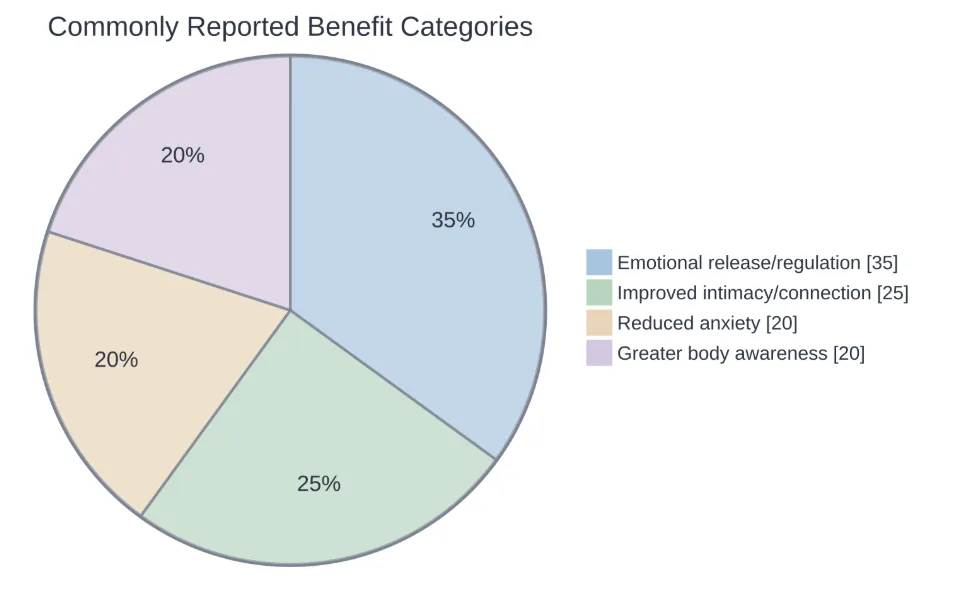
People who stick with the practice often describe feeling less reactive to stress, more comfortable in their own skin, and — for those practicing with a partner — a noticeable shift in how connected sex or touch feels. It's worth being honest, though: these are self-reported experiences, not clinical claims. Anyone dealing with significant anxiety or trauma should treat tantric meditation as a complement to, not a replacement for, professional support. For a gentler entry point into anxiety management specifically, structured anxiety relief sessions can be a useful place to start before layering in more advanced somatic work.
Neither format is a prerequisite for the other. Plenty of long-term practitioners never do partnered sessions at all, and that's completely fine. The solo version is arguably the better starting point anyway, since it builds the core skill — staying present with sensation — without the added layer of another person's reactions to manage.
A short list of things tantric meditation is not:
Start small. Five to ten minutes a day is plenty at first — there's no prize for marathon sessions early on. Keep a simple journal afterward, even a single line about what came up. Patterns tend to surface after a week or two that aren't obvious in the moment.
It also helps to separate this from performance. There's no "correct" feeling to produce, no benchmark to hit. Some days the body feels open and easy; other days it's tight and resistant. Both are valid data, not failures.
For those who find total silence hard to sit with, a visual or audio backdrop that adjusts to the length of a session can make the difference between quitting after two minutes and actually finishing the practice.
Tantric meditation isn't a shortcut or a gimmick. It's a slower, more embodied way of relating to experience — one that asks practitioners to feel first and interpret second. That's a genuinely different skill from the thought-watching most people associate with meditation, and it takes practice to feel natural.
The best way in is simply to start: a few quiet minutes, some slow breathing, and a willingness to notice whatever shows up without rushing to fix it. From there, the practice tends to teach itself. Anyone wanting a structured, guided way to build that habit can explore the customizable session options on Mesmerize's meditation plans, or browse the wider meditation and wellness blog for related body-awareness practices to pair alongside it.
I canceled my subscription with Headspace and I now pay for Mesmerize instead. I was hooked after the free trial! I love how customizable the sounds, meditations, and visuals are! Using this app has honestly become my favorite part of my day! ☺️ It helps me relax, meditate, visualize, sleep, and it does wonders for my anxiety/phobia/ocd tendencies. Thank you Mesmerize for giving us this amazing mental health tool! I told my therapist about this app and have been telling all my friends too. It’s just so helpful!
This is the second or third app in the mindfulness and meditation realm, and it’s the most scientific approach I have found. I have found these combinations of open monitoring, and focused attention meditation techniques are the most viable for those suffering from more severe forms of sleep, pain, and anxiety dysfunction one may be suffering from. Many of these approaches are used by professionals in a cognitive behavioral therapy setting. A truly complete approach in mindfulness and meditation.
I suffer from clinical depression and sometimes I get into a bad headspace but this app has really helped me whenever I’m in a bad mood I turn on the app listen to some person taking about breathing and look at cool figures on my phone and it makes me feel so much better I would highly recommend this app it’s worth the money
It didn’t take but five minutes of using this app to buy a yearly subscription. Worth it on so many levels. Easy to manipulate to what I like. Massive library of music, videos, etc.
Clear your mind and relax with a unique audio visual meditation experience.


.jpeg)