Discover Tara Brach's meditation teachings, the RAIN technique, and radical acceptance. Start a free guided practice today and build lasting calm.
.webp)
Quick Summary: Tara Brach is a psychologist, meditation teacher, and bestselling author known for blending Western psychology with Buddhist mindfulness practices, most notably through her RAIN technique and free weekly guided meditations. Her work focuses on self-compassion, emotional healing, and what she calls "radical acceptance" of present-moment experience. Beginners can access her meditations through her podcast, website, or apps like Insight Timer, and pair them with tools like Mesmerize for a more structured daily practice.
Millions of people search for calm every week, and a surprising number of them land on the same name: Tara Brach. Her voice — warm, unhurried, a little wry — has become something like a fixture in modern meditation culture. But what actually makes her approach different from the dozens of other teachers offering guided sits online?
The short answer? She doesn't just teach meditation. She teaches a way of relating to pain, shame, and fear that draws as much from clinical psychology as it does from decades of Buddhist study. That combination is why her talks resonate with people who've never set foot in a meditation hall.
Tara Brach, PhD, is a clinical psychologist, author, and meditation teacher based in the Washington, D.C. area, where she co-founded the Insight Meditation Community of Washington (IMCW). She's spent decades studying Buddhist meditation while also training in Western psychotherapy, and that dual background shows up in almost everything she teaches.
Her bestselling books — including Radical Acceptance, True Refuge, and Radical Compassion — have introduced her framework to readers well beyond the meditation world. She's also known for a weekly podcast that pairs a dharma talk with a guided meditation, a format she's kept remarkably consistent for years.
What sets her apart from many contemporary teachers isn't novelty. It's translation. She takes concepts that can sound abstract or intimidating — impermanence, non-attachment, loving-kindness — and grounds them in plain language about anxiety, grief, and self-judgment. That's a big part of why her audience skews so broad, from longtime Buddhist practitioners to people who just discovered meditation through a stressful year at work.
The phrase "radical acceptance" is probably the single most associated term with her teaching, and it's worth unpacking because it's often misunderstood. It doesn't mean passivity or resignation. It means meeting whatever arises — a painful emotion, a difficult memory, a physical sensation — without the usual layer of resistance or self-criticism that tends to make suffering worse.
Brach often describes people as living in a "trance of unworthiness," a default state of subtle self-judgment that colors how experience gets processed. Meditation, in her framework, is less about achieving some blissful blank state and more about interrupting that trance long enough to see what's actually happening, moment to moment, with some kindness attached.
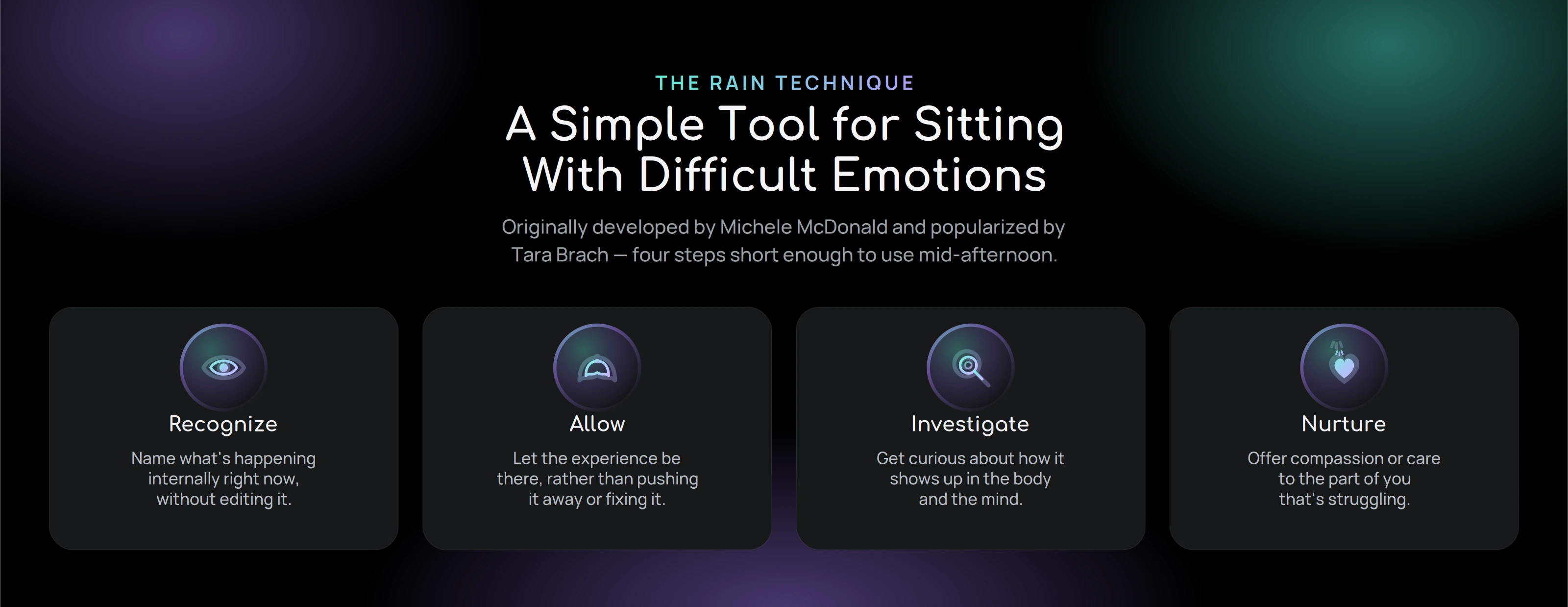
If there's one practical tool most associated with her work, it's RAIN - an acronym that stands for Recognize, Allow, Investigate, and Nurture. It was originally developed by another teacher, Michele McDonald, but Brach has done more than almost anyone to popularize and expand it for a general audience, particularly around difficult emotions like anxiety, anger, and grief.
The sequence is short enough to use in the middle of a stressful afternoon, which is likely why it's become a go-to tool for therapists and meditation teachers who reference her work.
Tara Brach meditation often combines mindfulness, compassion, and guided reflection. Mesmerize can complement that kind of practice with calming visuals, guided narration, soundscapes, and breathing exercises.
Mesmerize includes:
👉 Download Mesmerize for iPhone or for Android to try visual meditation for free.
Tara Brach's guided meditations are widely available for free, mostly through her website and podcast, and they tend to follow a recognizable rhythm. Most sessions open with a short body scan, move into breath awareness, and then spend the bulk of the time either sitting in open awareness or working with a specific theme — self-compassion, forgiveness, loving-kindness, or working with a specific difficult emotion.
Session lengths vary quite a bit, from short ten-minute check-ins to talks-plus-meditation combinations that run closer to forty-five minutes including the dharma talk. That range matters for accessibility: someone with three minutes before a meeting has options, and so does someone settling in for a full evening practice.
Newer practitioners sometimes find even the shorter sessions demanding at first — sitting with discomfort is, after all, the point. Pairing a guided talk-based practice with something more sensory can ease that transition. A short ten-minute guided session focused purely on visual and audio cues, for instance, can work well as a lead-in before tackling longer emotional-work meditations.
Not every meditation style asks practitioners to sit with difficult emotion the way RAIN does. Some approaches lean more toward relaxation, sensory immersion, or simple attention training. Understanding where her method sits on that spectrum helps in choosing what to try first.
None of these are mutually exclusive. In fact, a lot of long-term practitioners rotate between them depending on the day — a talk-based emotional practice on a hard morning, a purely sensory session like those offered through Mesmerize's subscription plans when the goal is simply to unwind before bed.
There's no strict prerequisite for trying her meditations — no cushion, no retreat, no prior training required. That said, a few practical habits make the practice stick.
Consistency tends to matter more than intensity here. A single forty-minute session once a month won't build much; ten minutes most days will, over a few weeks, start to shift how quickly someone can catch and work with a difficult emotional spiral.
Tara Brach's meditations are almost entirely talk-based — a voice guiding attention through language, pauses, and gentle instruction. That's powerful for emotional and psychological work, but it's a different mode from the visual and audio-driven relaxation many people also want, especially for sleep or acute stress relief where verbal processing isn't really the goal.
This is where a complementary tool can help round out a practice. Apps built around visual meditation, such as Mesmerize, work through different mechanisms — using moving imagery and layered soundscapes rather than spoken instruction — and the underlying approach is grounded in research on how visual stimulation affects the nervous system, detailed further on Mesmerize's research page. Many people find talk-based practices like Brach's more useful for processing a specific emotional event, while sensory-driven sessions work better for simply calming down before sleep or refocusing during a stressful workday.
The two aren't competitors so much as different tools for different moments. Someone dealing with a grief spiral might reach for a RAIN meditation. Someone just trying to fall asleep at 1 a.m. probably wants something with less talking and more ambient calm — the kind of session available through Mesmerize's app download for iOS and Android.
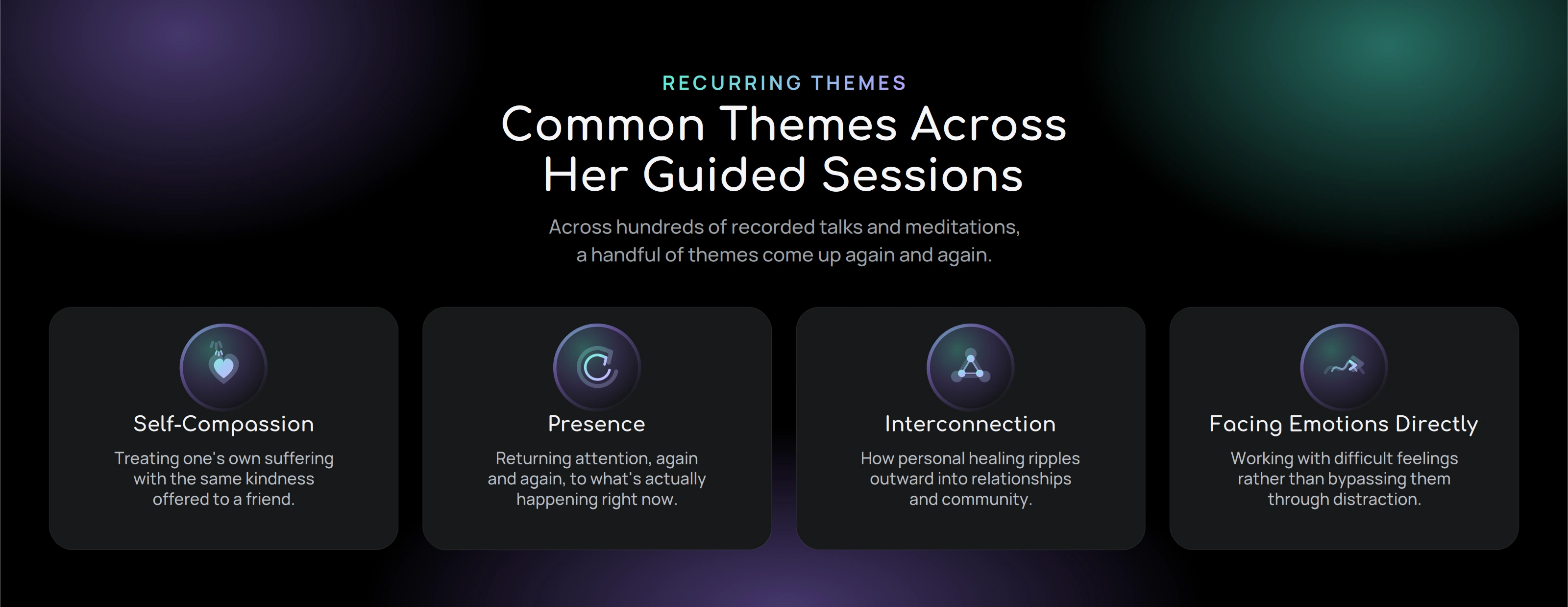
Across hundreds of recorded talks and meditations, a handful of themes come up again and again:
These themes give her body of work a kind of internal consistency, even across a huge catalogue of recordings spanning many years. New listeners can dip into almost any recent talk and pick up the throughline without needing to start from the beginning..
Tara Brach's lasting influence comes down to accessibility paired with depth. She's made concepts like radical acceptance and RAIN approachable enough for a total beginner while keeping enough substance to hold the interest of practitioners who've been sitting for decades. That balance is rare.
For anyone building a broader practice, her talk-based sessions pair naturally with other formats — including visual and sound-based relaxation tools for the moments when words aren't what's needed. Exploring Mesmerize's current plans or browsing more guidance on the Mesmerize blog is a reasonable next step for rounding out a daily practice that already includes teachers like Brach.
I canceled my subscription with Headspace and I now pay for Mesmerize instead. I was hooked after the free trial! I love how customizable the sounds, meditations, and visuals are! Using this app has honestly become my favorite part of my day! ☺️ It helps me relax, meditate, visualize, sleep, and it does wonders for my anxiety/phobia/ocd tendencies. Thank you Mesmerize for giving us this amazing mental health tool! I told my therapist about this app and have been telling all my friends too. It’s just so helpful!
This is the second or third app in the mindfulness and meditation realm, and it’s the most scientific approach I have found. I have found these combinations of open monitoring, and focused attention meditation techniques are the most viable for those suffering from more severe forms of sleep, pain, and anxiety dysfunction one may be suffering from. Many of these approaches are used by professionals in a cognitive behavioral therapy setting. A truly complete approach in mindfulness and meditation.
I suffer from clinical depression and sometimes I get into a bad headspace but this app has really helped me whenever I’m in a bad mood I turn on the app listen to some person taking about breathing and look at cool figures on my phone and it makes me feel so much better I would highly recommend this app it’s worth the money
It didn’t take but five minutes of using this app to buy a yearly subscription. Worth it on so many levels. Easy to manipulate to what I like. Massive library of music, videos, etc.
Clear your mind and relax with a unique audio visual meditation experience.


.jpeg)