Learn how third eye meditation works, step-by-step techniques, and benefits backed by science. Start your practice today with simple, guided exercises.
.webp)
Quick Summary: Third eye meditation is a focused practice that directs attention to the space between the eyebrows, often called the ajna or spiritual eye, with the goal of sharpening intuition, calming mental chatter, and deepening self-awareness. It typically involves seated stillness, steady breathing, and sustained soft focus on that midpoint, sometimes paired with visualization or sound. Most people notice subtle shifts—clarity, calm, vivid inner imagery—within a few weeks of consistent practice, though results vary widely from person to person.
Somewhere between yoga class small talk and late-night internet rabbit holes, the phrase "third eye" keeps coming up. It sounds mystical. It sounds like something reserved for monks on mountaintops. But strip away the mystique and third eye meditation is actually a fairly straightforward technique—one that's been practiced across multiple traditions for centuries, long before it showed up on wellness playlists.
This guide breaks down what the third eye actually refers to, how to meditate on it properly, and what to realistically expect. No incense required.
In yogic and tantric traditions, the third eye corresponds to the ajna chakra, the sixth of the seven primary energy centers in the body. It sits at the point between the eyebrows, slightly above, and is associated with perception, insight, and inner vision. Some traditions call it the "spiritual eye"—a term used by teachers like Paramahansa Yogananda to describe the same anatomical region as a gateway to expanded awareness.
Biologically, this spot roughly lines up with the pineal gland, a small structure deep in the brain that regulates melatonin and sleep-wake cycles. That anatomical proximity is partly why the third eye gets tied to concepts like intuition and "inner sight"—the idea being that focusing attention there stimulates something beyond ordinary visual perception.
Whether or not someone buys into the energetic framework, the practical experience tends to be consistent: sustained focus on that point produces a calm, inward-turned mental state that's noticeably different from regular eyes-closed rest.
It helps to see where ajna sits relative to other common meditation focal points.
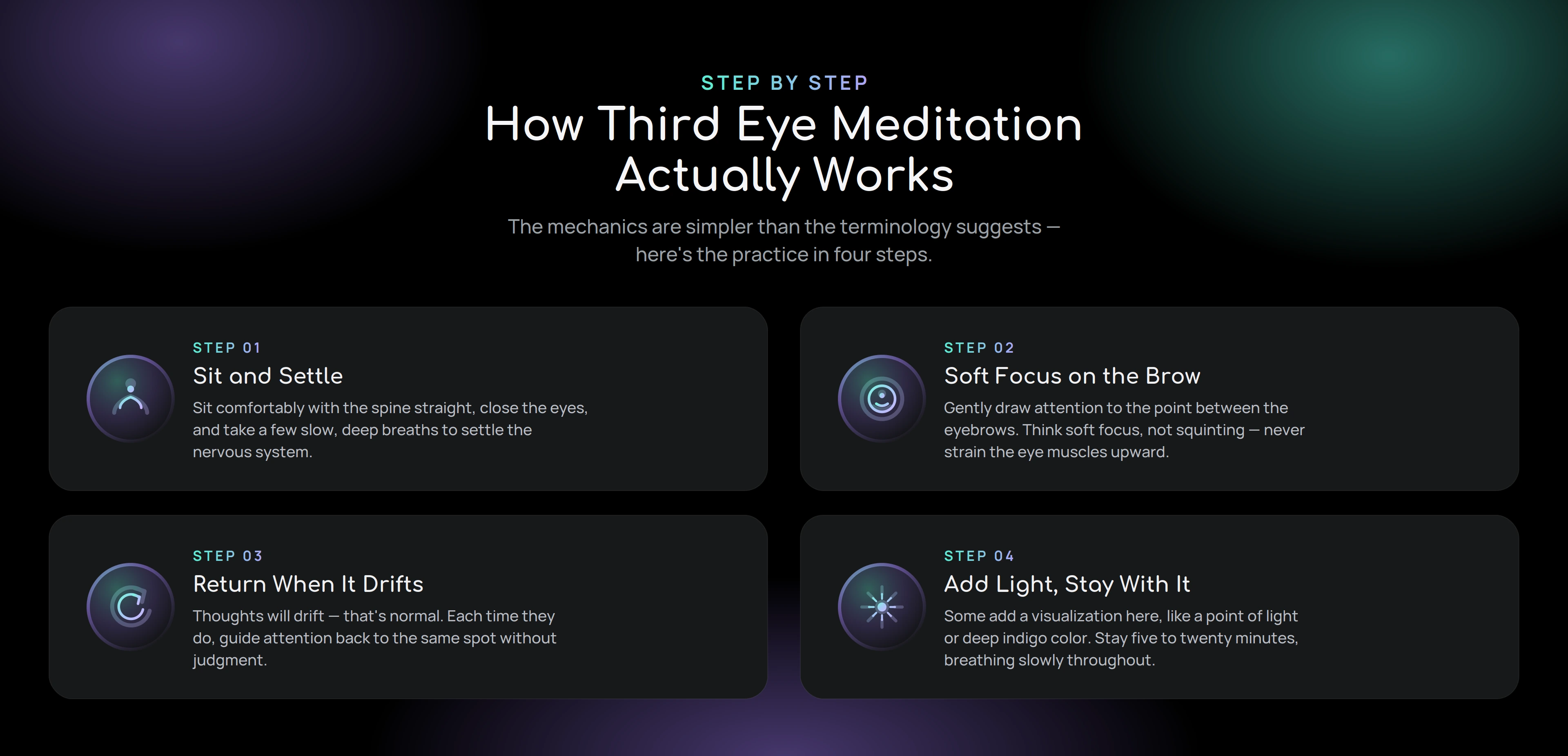
The mechanics are simpler than the terminology suggests. Here's a version that draws on common instructions found across yogic and mindfulness traditions:
That's the whole structure. No special equipment, no chanting required, though both can be layered in later.
It's common to feel a slight tingling, pressure, or warmth at the brow point during focused practice. Some describe it as a subtle pulsing. This is generally harmless and tends to fade as the muscles around the eyes relax into the technique. If there's actual pain or eye strain, that's a sign to ease off the intensity of focus rather than push through it.

Third eye meditation often involves focused attention, visualization, and controlled breathing. Mesmerize can add immersive visuals, guided narration, and customizable breathing patterns to that routine.
Mesmerize includes:
👉 Download Mesmerize for iPhone or for Android to try visual meditation for free.
Research on third eye meditation specifically is thin, but it overlaps heavily with broader meditation research, which has a much deeper evidence base. Studies on focused-attention meditation—of which this is a variant—consistently link regular practice to reduced stress markers, improved attention span, and better emotional regulation. The specific claims tied to "opening" the third eye, like heightened intuition or psychic perception, remain largely anecdotal and shouldn't be taken as clinically proven.
That said, the reported benefits people describe most often include:
Anyone curious about the physiological side of focused visual and meditative techniques can look at the research summarized on the science behind visual meditation, which covers how attention-based practices affect the nervous system more broadly.
People often ask how this differs from a regular mindfulness session. The core difference comes down to the anchor point.
Neither approach is superior—they're just different tools. Some practitioners rotate between the two depending on what a given day calls for.
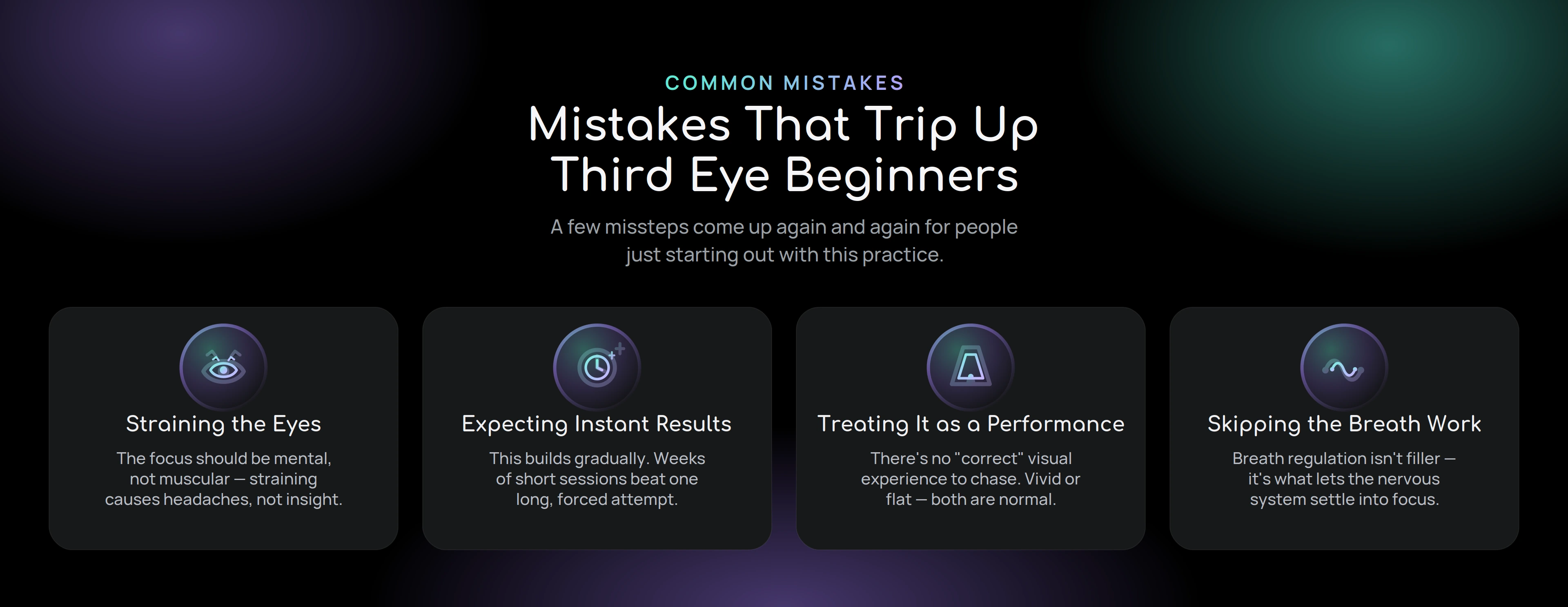
A few missteps come up again and again with beginners:
Consistency matters more than duration here. A short daily session tends to outperform occasional long ones. For anyone building a routine from scratch, starting with a brief structured practice—something like a focused 10-minute meditation session—can make the habit easier to sustain before layering in more advanced techniques like third eye focus.
Guided audio can also help, especially early on, since it removes the guesswork around pacing and timing. Visual and audio cues that sync with breath rhythm tend to make it easier to stay anchored at the brow point without the mind drifting off into planning tomorrow's errands. Apps built around audiovisual meditation, including Mesmerize's guided sessions, are designed with exactly that kind of structured pacing in mind.
Third eye meditation is generally safe for most people, but a few groups should approach it carefully. Anyone with a history of dissociation, psychosis, or severe anxiety disorders should check with a mental health professional before diving into intensive visualization practices, since intense inward focus can occasionally amplify existing symptoms rather than soothe them. People with migraines triggered by eye strain might also want to keep sessions short at first.
For most everyone else, it's a low-risk practice—one of the more accessible entry points into deeper meditation work, honestly, since it requires no equipment and can be done anywhere quiet enough to sit undisturbed for a few minutes.
Third eye meditation isn't about unlocking hidden powers overnight. It's a focused-attention technique with roots in centuries-old traditions, and its real value shows up gradually—in calmer thinking, steadier attention, and a quieter mental baseline. Whether the energetic framework resonates or not, the practical mechanics hold up on their own.
Start small: five minutes, seated, breathing slow, attention resting gently between the brows. For those wanting more structured guidance along the way, exploring meditation guides and techniques or trying a guided audiovisual session through a flexible meditation plan can make the early weeks a lot less trial-and-error. The rest, as with most meditation, comes down to simply showing up and sitting with it.
I canceled my subscription with Headspace and I now pay for Mesmerize instead. I was hooked after the free trial! I love how customizable the sounds, meditations, and visuals are! Using this app has honestly become my favorite part of my day! ☺️ It helps me relax, meditate, visualize, sleep, and it does wonders for my anxiety/phobia/ocd tendencies. Thank you Mesmerize for giving us this amazing mental health tool! I told my therapist about this app and have been telling all my friends too. It’s just so helpful!
This is the second or third app in the mindfulness and meditation realm, and it’s the most scientific approach I have found. I have found these combinations of open monitoring, and focused attention meditation techniques are the most viable for those suffering from more severe forms of sleep, pain, and anxiety dysfunction one may be suffering from. Many of these approaches are used by professionals in a cognitive behavioral therapy setting. A truly complete approach in mindfulness and meditation.
I suffer from clinical depression and sometimes I get into a bad headspace but this app has really helped me whenever I’m in a bad mood I turn on the app listen to some person taking about breathing and look at cool figures on my phone and it makes me feel so much better I would highly recommend this app it’s worth the money
It didn’t take but five minutes of using this app to buy a yearly subscription. Worth it on so many levels. Easy to manipulate to what I like. Massive library of music, videos, etc.
Clear your mind and relax with a unique audio visual meditation experience.


.jpeg)