Learn tonglen meditation step by step: the Tibetan compassion practice of breathing in pain and breathing out relief. Start your first session today.
.webp)
Quick Summary: Tonglen meditation is a Tibetan Buddhist practice where practitioners breathe in the pain and suffering of others and breathe out relief, compassion, and healing. It reverses the usual instinct to avoid discomfort, using the breath as a vehicle for building empathy and connection with people who are struggling, including yourself. Anyone can practice it in ten minutes with no special equipment, and its core skill transfers well into modern stress-relief and mindfulness routines.
Most meditation styles ask practitioners to relax, breathe, and let go of tension. Tonglen does something almost the opposite. It asks people to breathe *in* pain on purpose. That sounds backwards until you understand what it's actually training: the capacity to stay open in the presence of suffering instead of flinching away from it.
The word "tonglen" comes from Tibetan and roughly translates to "sending and taking" or "giving and receiving." It's one of the older contemplative tools in the Tibetan Buddhist tradition, and it became widely known in the West largely through teachers like Chögyam Trungpa and Pema Chödrön, who reframed it as an accessible compassion practice rather than an obscure ritual. Today it shows up in secular mindfulness circles, therapy-adjacent wellness spaces, and guided meditation apps, often stripped of religious framing but keeping its emotional core intact.
At its simplest, tonglen is a breath-based visualization. On the in-breath, the practitioner imagines drawing in someone else's suffering — their fear, grief, illness, or stress. On the out-breath, they send back something that could ease it: comfort, space, warmth, or relief. It's a direct inversion of the usual self-protective habit of pushing pain away and pulling comfort toward oneself.
That inversion is the whole point. Tonglen isn't really about fixing anyone else's problem. It's a way of loosening the tight grip most people keep around their own comfort, and that loosening tends to generate real compassion rather than a performed version of it.
Tonglen is traditionally practiced in four stages, moving from simple awareness into a wider compassion practice. Following the sequence can make it easier to settle into the exercise.
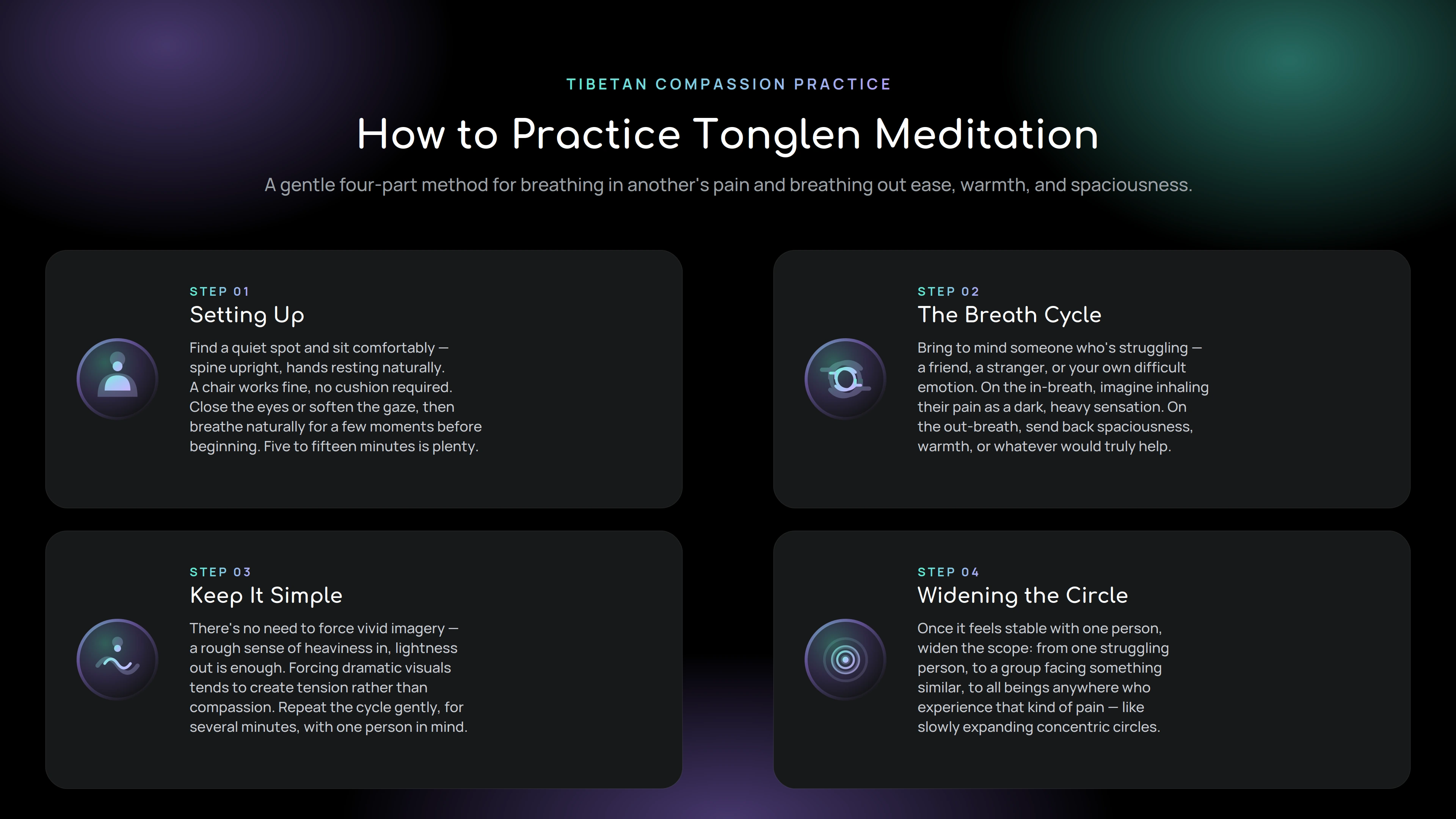
Find a quiet spot and sit comfortably, spine reasonably upright, hands resting wherever feels natural. Tonglen doesn't require a cushion or incense — a chair works fine. Close the eyes or let the gaze soften, and take a few natural breaths before doing anything deliberate. Sessions of five to fifteen minutes are plenty for most people, especially early on.
Once settled, bring to mind someone who's struggling — it could be a friend going through a hard diagnosis, a stranger seen briefly on the news, or, for some sessions, the practitioner's own difficult emotion. On the in-breath, imagine inhaling their pain as a dark, heavy sensation. On the out-breath, imagine sending back spaciousness, warmth, or whatever quality would genuinely help.
Repeat this cycle for several minutes with one person in mind. There's no need to force vivid imagery — a rough sense of heaviness in and lightness out is enough. Forcing dramatic visualization tends to create tension rather than compassion.
Once the practice feels stable with one person, it's traditional to widen the scope: from one struggling person, to a group facing something similar, to all beings experiencing that kind of pain anywhere. This progression mirrors the four stages above and is often illustrated as an expanding set of concentric circles.
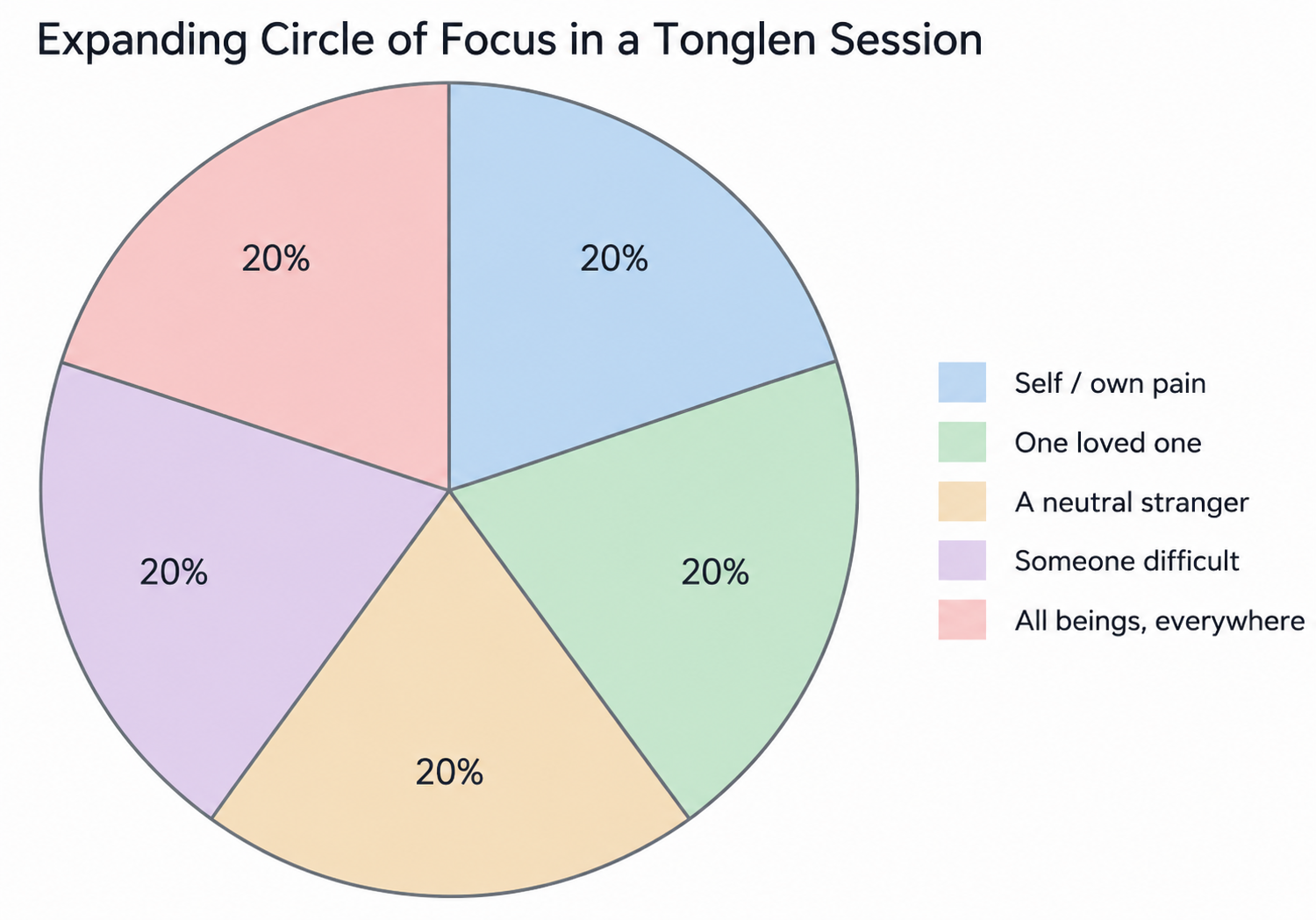
The five focus points a tonglen practitioner typically cycles through in an extended session.
Many teachers recommend beginners start by directing tonglen toward their own suffering before extending it outward. Breathing in your own anxiety and breathing out steadiness toward yourself sounds almost too simple, but it builds the emotional muscle needed before attempting it for someone else's harder situation. Skipping this step is one of the more common reasons people report the practice feeling forced.
Tonglen meditation is a Tibetan Buddhist practice centered on compassion and intentional breathing. Mesmerize can help create a quiet setting with visual breathing, calming soundscapes, and customizable breathing patterns.
Mesmerize includes:
👉 Download Mesmerize for iPhone or for Android to try visual meditation for free.
Tonglen gets compared often to loving-kindness (metta) meditation since both build compassion. They're related but not identical, and picking the wrong one for a given mood can make a session feel flat.
Neither approach is objectively "better." Some practitioners rotate between the two depending on what a given day calls for — loving-kindness on calmer days, tonglen when something specific and heavy needs processing.
New practitioners run into a handful of predictable snags. Here's what tends to trip people up, and simple adjustments that help:
Tonglen doesn't require any particular religious belief to be useful. Its underlying mechanism — deliberately turning toward discomfort instead of avoiding it — overlaps with techniques used in modern approaches to emotional regulation and stress reduction. Some of the growing interest in visual and audio-guided meditation reflects the same idea: giving the mind a structured, sensory anchor makes it easier to stay present with difficult material rather than getting swept away by it. Research summarized on the science behind visual meditation touches on why sensory-guided formats can support this kind of sustained attention.
For anyone who finds pure breath-and-visualization work difficult to sustain without wandering, pairing tonglen with a structured audio-visual session can help anchor attention. A short guided format, like the one in this ten-minute guided meditation, works well as a warm-up before attempting a longer compassion practice, since it settles the nervous system before the more demanding emotional work begins.
Consistency matters more than duration here. A five-minute daily session tends to build more resilience than an occasional thirty-minute one. Many people anchor it to an existing habit — right after morning coffee, or right before sleep — so it doesn't rely on willpower alone.
Those who prefer structured guidance rather than freeform visualization sometimes turn to apps offering customizable session lengths and themes. Browsing available subscription plans or checking out the broader collection of meditation guides can help someone figure out what format actually sticks, since the format that works varies a lot from person to person.
Tonglen isn't complicated to begin, even if it takes time to feel natural. All it really needs is a few quiet minutes, a person or situation to hold in mind, and a willingness to breathe in something uncomfortable on purpose. That's a small ask for a practice with this much history behind it.
For those who want a structured entry point rather than starting from a blank page, exploring guided sessions can smooth the learning curve considerably. Check the Mesmerize app download page for iOS and Android, or review current pricing and purchase options to see whether a guided visual meditation format fits into a daily compassion practice.
I canceled my subscription with Headspace and I now pay for Mesmerize instead. I was hooked after the free trial! I love how customizable the sounds, meditations, and visuals are! Using this app has honestly become my favorite part of my day! ☺️ It helps me relax, meditate, visualize, sleep, and it does wonders for my anxiety/phobia/ocd tendencies. Thank you Mesmerize for giving us this amazing mental health tool! I told my therapist about this app and have been telling all my friends too. It’s just so helpful!
This is the second or third app in the mindfulness and meditation realm, and it’s the most scientific approach I have found. I have found these combinations of open monitoring, and focused attention meditation techniques are the most viable for those suffering from more severe forms of sleep, pain, and anxiety dysfunction one may be suffering from. Many of these approaches are used by professionals in a cognitive behavioral therapy setting. A truly complete approach in mindfulness and meditation.
I suffer from clinical depression and sometimes I get into a bad headspace but this app has really helped me whenever I’m in a bad mood I turn on the app listen to some person taking about breathing and look at cool figures on my phone and it makes me feel so much better I would highly recommend this app it’s worth the money
It didn’t take but five minutes of using this app to buy a yearly subscription. Worth it on so many levels. Easy to manipulate to what I like. Massive library of music, videos, etc.
Clear your mind and relax with a unique audio visual meditation experience.


.jpeg)