Discover trataka meditation, the ancient candle-gazing technique for focus and calm. Learn the steps, benefits, and precautions—start your practice today.
.webp)
Quick Summary: Trataka meditation is a Hatha yoga technique that involves fixing an unwavering gaze on a single point, such as a candle flame, until the eyes water and the mind settles into stillness. Rooted in classical texts like the Hatha Yoga Pradipika, it's used today for concentration, stress relief, and eye health, and pairs naturally with other visual focusing practices. Anyone with basic vision and a quiet room can try it, though certain eye conditions call for caution.
There's something almost stubborn about trataka. While most meditation traditions tell you to close your eyes and drift inward, trataka does the opposite. It asks you to keep your eyes open, locked on one point, refusing to blink until your body practically forces you to look away. That contradiction is exactly why it works.
Practitioners have used this gazing technique for centuries as a way to train attention, calm a restless mind, and sharpen inner focus. It's simple in concept but surprisingly demanding in practice — which is probably why it still shows up in yoga studios, wellness apps, and ancient manuscripts alike.
Trataka comes from Sanskrit and roughly translates to "to look" or "to gaze." It's classified in Hatha yoga as one of the shatkarmas, a set of cleansing practices, but it's also widely taught as a standalone meditation technique. The classical Hatha Yoga Pradipika describes the practice as staring steadily at a small point without blinking, continuing until tears begin to form.
That detail about tears isn't poetic exaggeration. Sustained, unblinking focus genuinely does trigger the eyes to water — it's a natural response, not a sign of doing something wrong. In the traditional framework, this tearing is even considered part of the cleansing effect, flushing and refreshing the eyes while the mind undergoes its own kind of clearing.
What sets trataka apart from most seated meditation styles is its use of external, visual anchoring. Instead of watching the breath or repeating a mantra internally, attention rests on something outside the body — a candle flame, a dot on a wall, a symbol, or even the moon. That external point becomes the leash that keeps a wandering mind in place.
Here's the thing though — the eyes and the mind are far more linked than most people assume. Visual attention and mental attention tend to move together. When the eyes dart around, thoughts usually scatter too. Fix the gaze, and mental chatter tends to slow down almost as a side effect.
Trataka essentially uses the eyes as a training tool for concentration, a mental faculty yogic tradition called dharana. Instead of fighting distracting thoughts directly, the practitioner gives the mind one simple, unchanging job: watch this point. Everything else — the itch, the noise outside, tomorrow's to-do list — gets gently pushed to the background because there's only room for one point of focus.
Modern audio-visual relaxation tools build on a similar principle, using light and pattern to give a restless mind something steady to latch onto. That's part of why visual meditation formats have gained traction as an easier entry point for people who find silent, eyes-closed meditation hard to sustain — the research behind visual meditation's effectiveness points to similar mechanisms of attention anchoring.
Not every trataka session looks the same. Traditional teachings generally split the practice into two broad categories, though there's plenty of variation within each.
Candle gazing, or jyoti trataka, is probably the most widely taught version, largely because a flickering flame is naturally engaging without being overstimulating. Bindu trataka, using a plain dot, is often recommended for people who want something they can practice anywhere without needing an actual flame nearby.
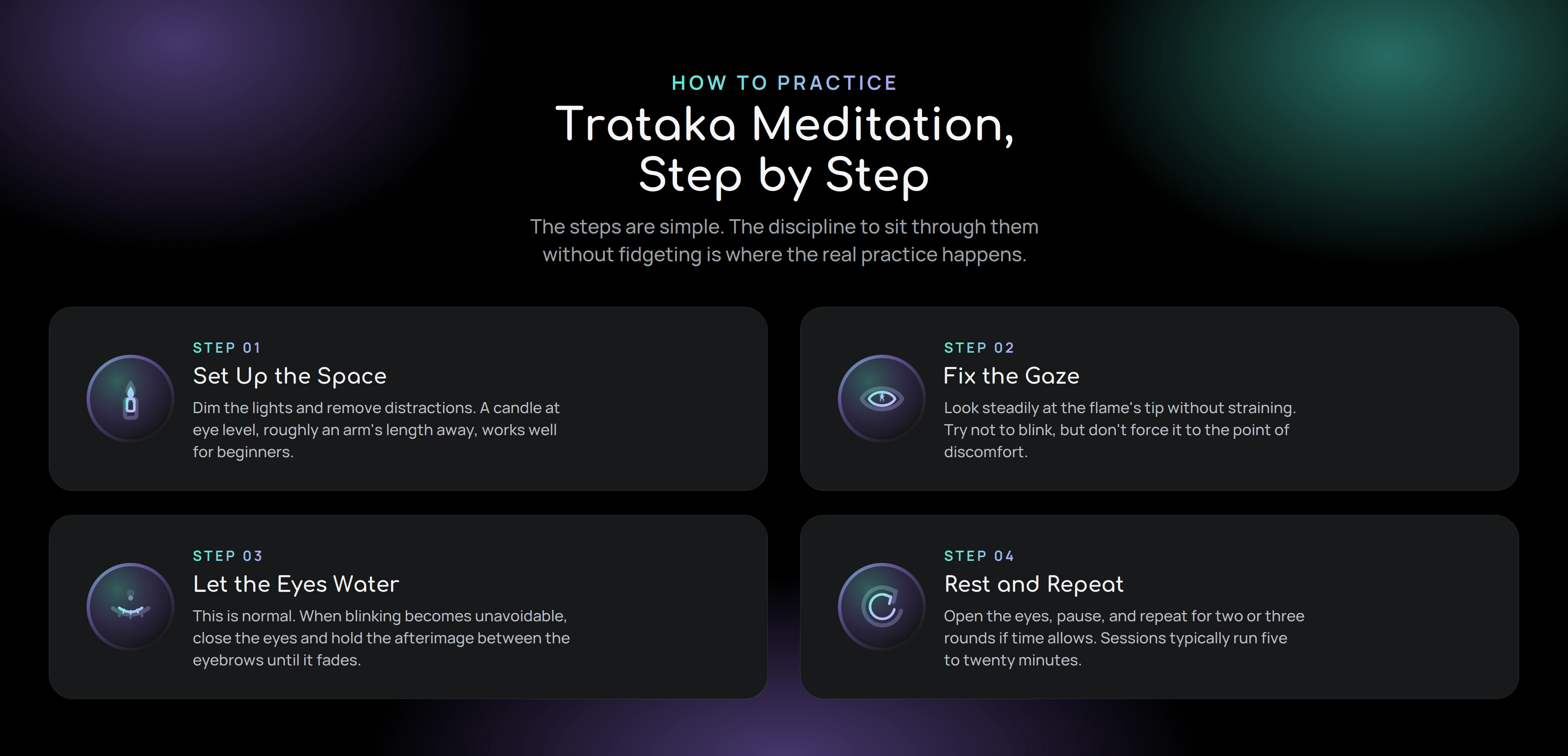
The steps themselves are simple. The discipline required to sit through them without fidgeting is where the real practice happens.
Sessions typically run somewhere between five and twenty minutes. Beginners generally do better starting short — even a couple of minutes of steady gazing can feel intense at first — and building duration gradually. Anyone easing into a meditation habit for the first time might find it easier to pair trataka with a short guided routine, like the format used in a 10-minute daily meditation session, rather than jumping straight into a long unguided practice.
Trataka meditation uses a fixed visual point to support concentration. Mesmerize offers animated visual patterns that can provide a different type of visual focus, paired with calming audio and breathing exercises.
Mesmerize includes:
👉 Download Mesmerize for iPhone or for Android to try visual meditation for free.
Trataka gets credited with a long list of benefits in traditional texts, and while not every claim has been rigorously tested by modern science, several effects line up with what's known about attention training and the nervous system.
None of this means trataka is a cure-all. It's a concentration tool, and like any tool, its value depends on how consistently it's used and how well it fits a person's actual needs.
What's interesting is how closely trataka's core mechanism — sustained visual focus that quiets mental noise — echoes what contemporary visual meditation apps try to recreate digitally. Instead of a candle, these tools use slowly shifting light patterns, color, and sound designed to hold attention in a similarly effortless way.
That's not a coincidence. The underlying principle is the same: give the eyes one steady thing to do, and the mind tends to follow. Apps built around visual meditation experiences for iOS and Android essentially digitize the candle-gazing concept, making it accessible without needing a dark room or an actual open flame — useful for anyone practicing in a shared space or somewhere open flames aren't practical.
For people curious about structured, customizable sessions rather than freeform candle gazing, it's worth comparing the two approaches directly.
Those exploring which format suits their lifestyle better can look through the available subscription plans and session features to see how customizable options compare with a traditional candle-based routine.
Trataka is generally considered safe for healthy adults, but it's not universally suitable. People with glaucoma, cataracts, retinal issues, or a history of migraines triggered by bright light should check with an eye specialist before attempting sustained candle gazing. Epilepsy, particularly photosensitive epilepsy, is another condition where flickering flames or light patterns warrant real caution.
Straining the eyes is also a common beginner mistake. The gaze should stay soft and steady, not forced wide open. If the eyes start to burn or vision blurs excessively, that's the signal to stop, blink, and rest rather than push through discomfort in the name of "doing it right."
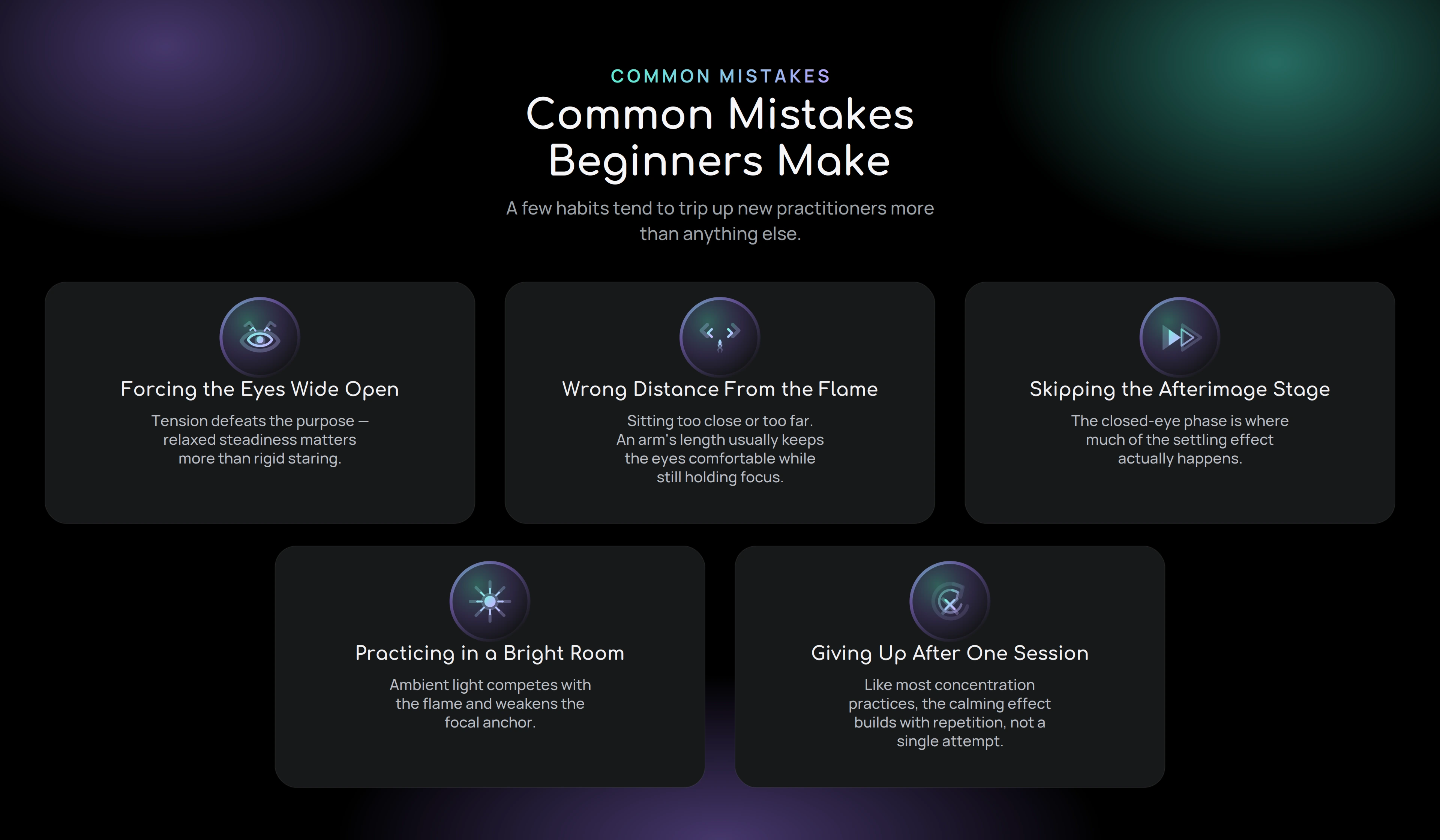
A few habits tend to trip up new practitioners more than anything else.
Trataka isn't complicated, but it does ask for a bit of patience — the kind that builds over repeated sittings rather than one dramatic session. Start small, keep the room dim, and let the eyes do their quiet work without forcing anything.
For anyone who wants a more structured entry point, pairing candle-style focus with guided audio-visual formats can smooth the learning curve considerably. Exploring the collection of meditation guides and wellness articles is a reasonable next step, and for those ready to try a digital take on visual focus meditation, checking the pricing and purchase options for a dedicated app is worth a look before committing to a routine.
Whether it's a flickering candle in a dark room or a guided light pattern on a screen, the goal stays the same: one steady point, one settled mind.
I canceled my subscription with Headspace and I now pay for Mesmerize instead. I was hooked after the free trial! I love how customizable the sounds, meditations, and visuals are! Using this app has honestly become my favorite part of my day! ☺️ It helps me relax, meditate, visualize, sleep, and it does wonders for my anxiety/phobia/ocd tendencies. Thank you Mesmerize for giving us this amazing mental health tool! I told my therapist about this app and have been telling all my friends too. It’s just so helpful!
This is the second or third app in the mindfulness and meditation realm, and it’s the most scientific approach I have found. I have found these combinations of open monitoring, and focused attention meditation techniques are the most viable for those suffering from more severe forms of sleep, pain, and anxiety dysfunction one may be suffering from. Many of these approaches are used by professionals in a cognitive behavioral therapy setting. A truly complete approach in mindfulness and meditation.
I suffer from clinical depression and sometimes I get into a bad headspace but this app has really helped me whenever I’m in a bad mood I turn on the app listen to some person taking about breathing and look at cool figures on my phone and it makes me feel so much better I would highly recommend this app it’s worth the money
It didn’t take but five minutes of using this app to buy a yearly subscription. Worth it on so many levels. Easy to manipulate to what I like. Massive library of music, videos, etc.
Clear your mind and relax with a unique audio visual meditation experience.


.jpeg)