Learn how unplug meditation helps you disconnect from screens, ease stress, and sleep better. Start a simple 10-minute practice today with this guide.
.webp)
Quick Summary: Unplug meditation is the practice of deliberately stepping away from screens and notifications to focus inward through guided or visual meditation. It works by giving the nervous system a break from constant digital stimulation, which research links to lower stress and better sleep. Starting small — even ten minutes a day without a phone in reach — is usually enough to notice a difference within a week or two.
Phones buzz. Tabs pile up. Notifications arrive before the last one's even been read. Somewhere in that noise, the idea of "unplug meditation" started gaining traction — not as another wellness trend, but as a practical response to a very real problem: most people are never actually off.
Unplug meditation blends two things that sound almost contradictory in 2026 — meditation, which asks for stillness, and "unplugging," which asks for absence. Put them together and the result is a deliberate practice of stepping away from screens long enough to let the mind settle. It's less about escaping technology forever and more about creating a reliable pocket of quiet in an otherwise loud day.
At its core, unplug meditation is any meditative practice done with digital distractions removed from the picture. That might mean putting the phone in another room during a ten-minute breathing session, or it might mean a guided visual meditation that replaces scrolling with something calmer to look at and listen to.
It's not the same as a strict digital detox, where someone avoids devices for days or weeks. Unplug meditation is smaller and more repeatable — a short, structured break rather than a lifestyle overhaul. That's part of why it's caught on: it fits into a lunch break, a commute, or the ten minutes before bed.
Average daily screen time has climbed steadily for years, and most of that time is fragmented — a few minutes here, a notification there, rarely a sustained block of focus. The nervous system doesn't get much recovery time in between. Unplug meditation works because it inserts a deliberate pause, one long enough for the body to shift out of that low-grade alert state screens tend to produce.
Meditation's effects on stress, attention, and sleep are well documented at this point — slower breathing, lower heart rate, reduced activity in the brain's stress-response centers. What's newer is the growing interest in how screen exposure interacts with those same systems. Blue light, rapid visual switching, and the anticipation baked into notifications all keep the sympathetic nervous system mildly activated. Removing that input, even briefly, gives the parasympathetic system — the "rest and digest" side — room to take over.
Visual meditation, in particular, has drawn attention because it gives the eyes and mind something calm to focus on instead of nothing at all, which some people find harder to sustain than a guided visual experience. For readers curious about the research side of this, the science behind visual meditation breaks down what's been studied so far.
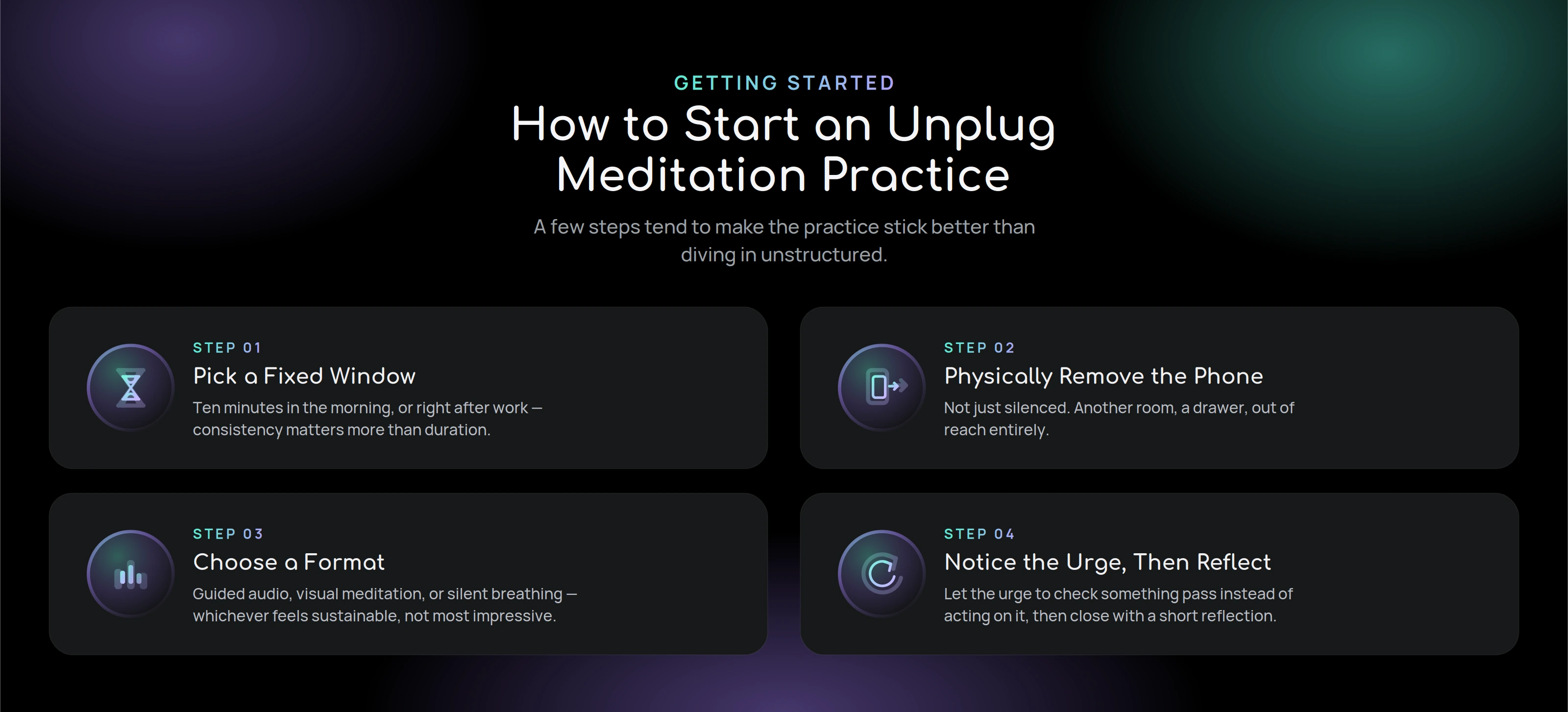
There's no single correct way to do this, but a few steps tend to make the practice stick better than diving in unstructured.
New practitioners often do better with something guided rather than silent stillness, mainly because an unstructured ten minutes can feel longer than expected when there's no anchor. A short guided session, like a 10-minute daily meditation practice, tends to bridge that gap well.
Not every unplug session looks the same. Some people want full silence; others want structure and visuals to hold their attention. The table below breaks down the most common formats.
Guided audio meditations lean on a voice to walk the mind through the process — helpful for people who find pure silence hard to settle into. Visual meditation takes a different route entirely, using slow-moving imagery and sound together to hold attention without needing words at all. Neither is objectively better; it comes down to what actually keeps someone engaged for the full session instead of reaching for a phone at minute four.
Decision path for picking a meditation style based on personal preference.
Ironically, a lot of unplug meditation happens through an app — the goal isn't zero technology, it's better technology use. A well-designed session on a phone, followed by the phone going face-down for the duration, still counts. What matters is whether the tool encourages a real break or just adds another tab to check.

Unplug Meditation focuses on making meditation easier to fit into everyday life. Mesmerize offers a similarly accessible option through quick presets, guided sessions, animated visuals, and calming audio that can be used almost anywhere.
Mesmerize includes:
👉 Download Mesmerize for iPhone or for Android to try visual meditation for free.
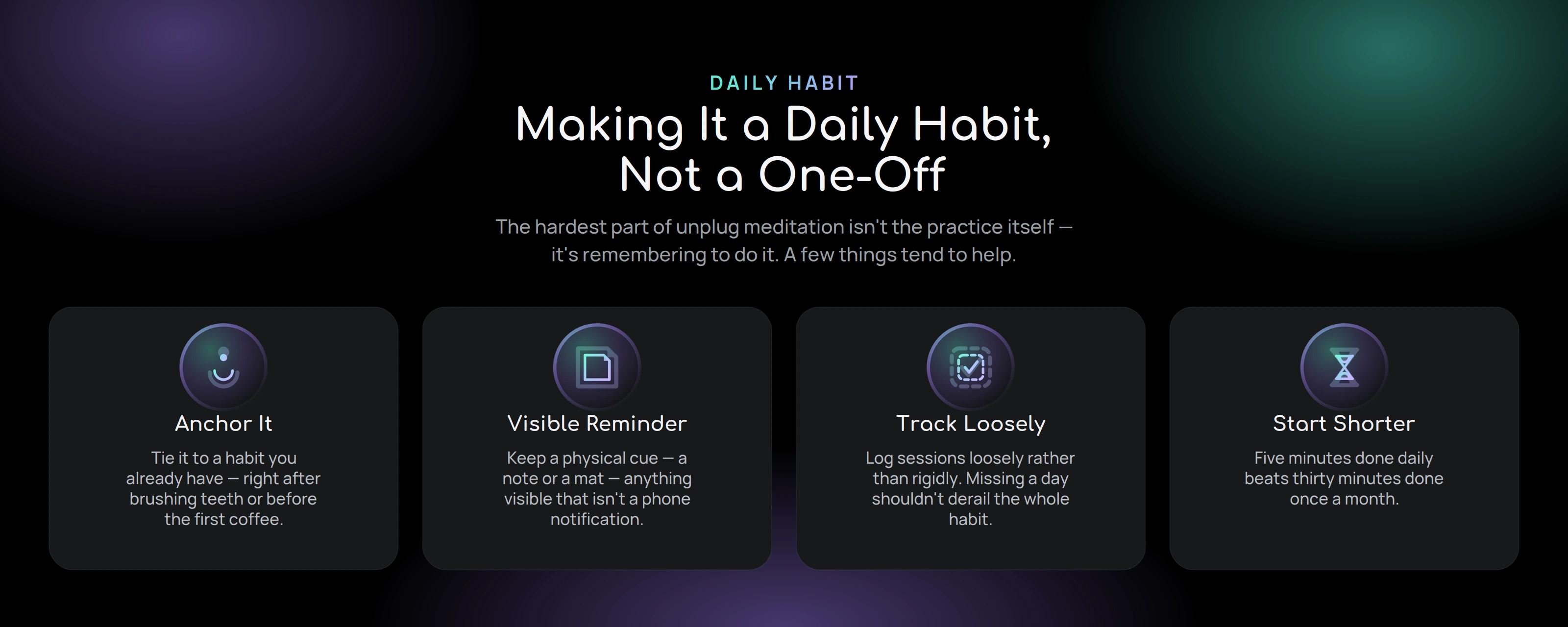
The hardest part of unplug meditation usually isn't the meditation itself — it's remembering to do it consistently. A few things tend to help:
For anyone unsure where to start, downloading a guided app and testing a short session is usually the lowest-friction entry point. The Mesmerize app for iOS and Android offers exactly that kind of low-commitment first step, and the meditation guides and wellness articles on the site cover related practices worth exploring afterward.
Most people who try unplug meditation and quit do so for one of a few predictable reasons: they expect instant calm, they pick a format that bores them, or they don't remove the phone from the room. None of these are hard to fix once they're named.
The expectation problem is probably the biggest one. Meditation, unplugged or not, rarely produces dramatic results after a single session. The benefits tend to show up as a gradual shift — slightly easier sleep onset, a bit less reactivity to minor irritations, a calmer baseline over a couple of weeks. Judging it after one try skips the part where it actually works.
Unplug meditation isn't about rejecting technology altogether. It's about reclaiming small windows of the day where attention actually belongs to the person holding it, not to whatever app pinged last. Start with ten minutes. Put the phone somewhere else. Choose a format that actually holds interest, whether that's guided audio, a quiet walk, or a visual meditation session designed for exactly this kind of reset.
Anyone ready to try a structured version of this can explore downloading the Mesmerize app and testing a session today — it takes less time than scrolling through one more feed.
I canceled my subscription with Headspace and I now pay for Mesmerize instead. I was hooked after the free trial! I love how customizable the sounds, meditations, and visuals are! Using this app has honestly become my favorite part of my day! ☺️ It helps me relax, meditate, visualize, sleep, and it does wonders for my anxiety/phobia/ocd tendencies. Thank you Mesmerize for giving us this amazing mental health tool! I told my therapist about this app and have been telling all my friends too. It’s just so helpful!
This is the second or third app in the mindfulness and meditation realm, and it’s the most scientific approach I have found. I have found these combinations of open monitoring, and focused attention meditation techniques are the most viable for those suffering from more severe forms of sleep, pain, and anxiety dysfunction one may be suffering from. Many of these approaches are used by professionals in a cognitive behavioral therapy setting. A truly complete approach in mindfulness and meditation.
I suffer from clinical depression and sometimes I get into a bad headspace but this app has really helped me whenever I’m in a bad mood I turn on the app listen to some person taking about breathing and look at cool figures on my phone and it makes me feel so much better I would highly recommend this app it’s worth the money
It didn’t take but five minutes of using this app to buy a yearly subscription. Worth it on so many levels. Easy to manipulate to what I like. Massive library of music, videos, etc.
Clear your mind and relax with a unique audio visual meditation experience.


.jpeg)