Discover how Vedic meditation uses mantras to calm the mind and reduce stress. Learn the technique, benefits, and how to start your practice today.
.webp)
Quick Summary: Vedic meditation is a mantra-based practice rooted in India's ancient wisdom traditions, typically taught over several days by a certified teacher and practiced for about 20 minutes twice daily with eyes closed. It works by using a personal sound, or mantra, to help the mind settle naturally into a restful, alert state without forced concentration. Most practitioners report calmer stress responses, better sleep, and sharper focus within weeks of consistent practice.
Somewhere between the incense-heavy yoga studio and the corporate wellness seminar, Vedic meditation quietly became one of the most talked-about practices in modern mindfulness circles. It's not new — the roots stretch back thousands of years — but it's having a moment. Executives swear by it. Musicians credit it for their creative stamina. Even skeptics who've tried every meditation app under the sun tend to say this one feels different.
So what actually separates Vedic meditation from the guided breathing exercises and body scans that dominate wellness apps? The short answer: mantra. This piece breaks down what Vedic meditation is, how a course typically works, why the technique uses sound rather than silence, and how it stacks up against other relaxation practices — including visual and audio-based approaches that skip the mantra altogether.
Vedic meditation is a mantra-based technique drawn from the Vedas, a body of ancient Indian texts that also gave rise to yoga and Ayurveda. Unlike mindfulness meditation, which asks practitioners to observe thoughts as they arise, Vedic meditation uses a specific sound — a mantra — as a vehicle for the mind to settle inward, below the layer of active thinking.
Practitioners sit comfortably with eyes closed for roughly 20 minutes, twice a day, silently repeating their mantra. There's no effort to concentrate, no attempt to block out thoughts, and no need to sit cross-legged on the floor. A chair works fine. The mind is simply given something quieter to attend to than the usual mental noise, and it tends to drift toward stillness on its own.
That effortlessness is the technique's calling card. Where many meditation styles require active attention — watching the breath, labeling emotions, scanning the body — Vedic meditation is often described as "restfully alert." The nervous system settles while awareness stays present, which is a different physiological state than sleep or ordinary waking rest.
Vedic meditation traces back to oral traditions passed from teacher to student across generations in India, long before the practice was written down. The technique gained wider visibility in the West during the mid-20th century, when Transcendental Meditation — a specific, trademarked branch of the same lineage — was introduced internationally and popularized by high-profile teachers and their students.
Today, "Vedic meditation" is used more broadly to describe mantra-based techniques from this same tradition, taught by a range of certified instructors outside the TM organization. The core mechanics are similar enough that the two terms are often used loosely, though teachers within each lineage tend to draw firm distinctions about training, certification, and mantra selection.
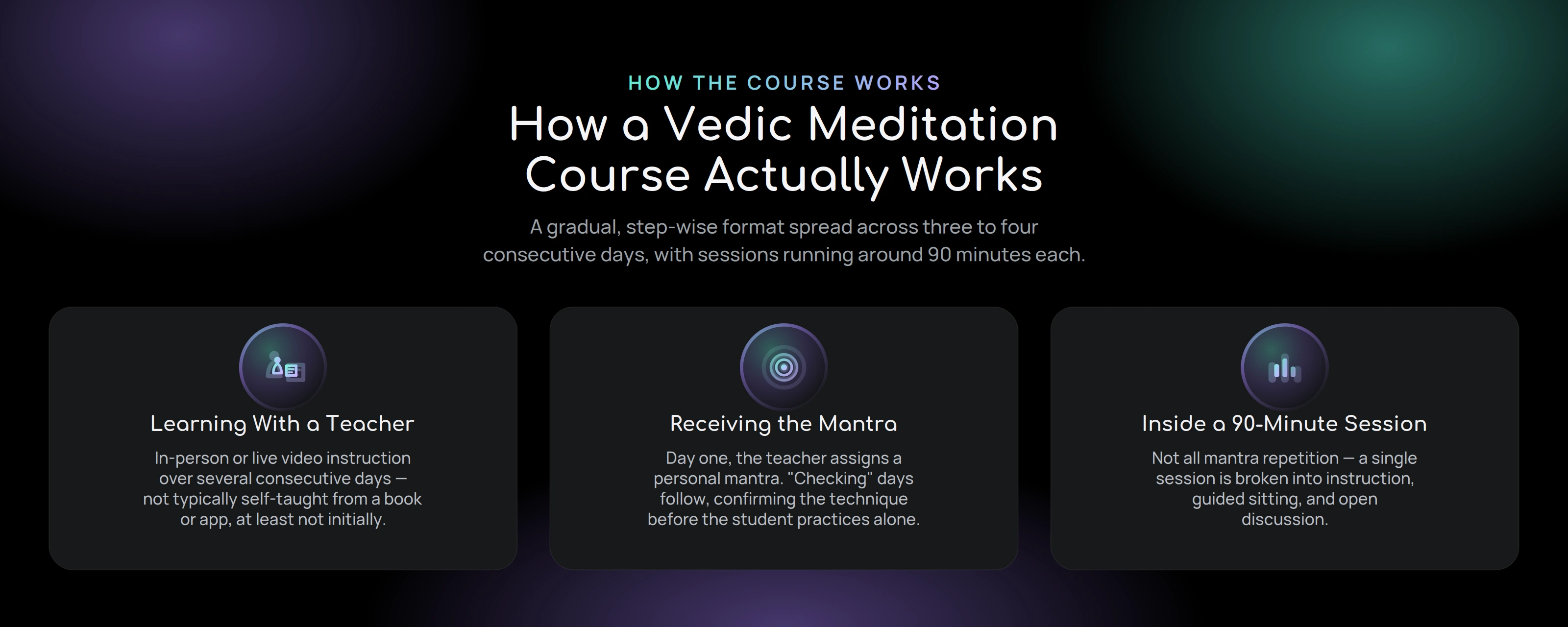
Vedic meditation isn't typically self-taught from a book or app, at least not initially. Most teachers require in-person or live video instruction spread across three to four consecutive days, with sessions running around 90 minutes each. This gradual, step-wise format gives the mind time to adjust and gives the student a chance to ask questions as the technique settles in.
On the first day, the teacher assigns a personal mantra and walks the student through the initial sitting. The following sessions are "checking" days, where the teacher confirms the technique is being practiced correctly and answers whatever's come up - restlessness, skepticism, odd sensations, all of it is normal. By the final day, the goal is a self-sufficient daily routine the student can carry forward without ongoing supervision.
A single 90-minute session usually isn't all mantra repetition. It's broken into instruction, guided sitting, and open discussion.

Vedic meditation is generally practiced quietly with a mantra and minimal distraction. Mesmerize can help create a relaxed environment before or after a session with calming audio, visuals, and breathing tools.
Mesmerize includes:
👉 Download Mesmerize for iPhone or for Android to try visual meditation for free.
The mantra is the mechanism, not the metaphor. In Vedic meditation, teachers often use a Bija mantra — a category of short, seed-like sounds chosen for their vibrational quality rather than literal meaning. Bija mantras don't translate to a sentence or an idea; the sound itself is the point. That's a deliberate design choice, since assigning meaning to the mantra would give the thinking mind something to chew on, which defeats the purpose.
Teachers typically select a mantra based on general criteria rather than picking one at random, and students are usually asked to keep it private. Whether that privacy is essential to the technique's effectiveness or simply tradition is debated, but it's a near-universal instruction across teaching lineages.
Comparing meditation styles side by side helps clarify what makes Vedic meditation distinct, especially for anyone comparing it against mindfulness apps or newer visual and audio-based relaxation tools.
Neither approach is objectively superior — they solve slightly different problems. Vedic meditation offers a highly structured, repeatable technique with a human teacher behind it. Visual and audio-based practices, like the guided sessions inside the Mesmerize app, trade that structure for accessibility, letting anyone start relaxing within minutes without formal training.
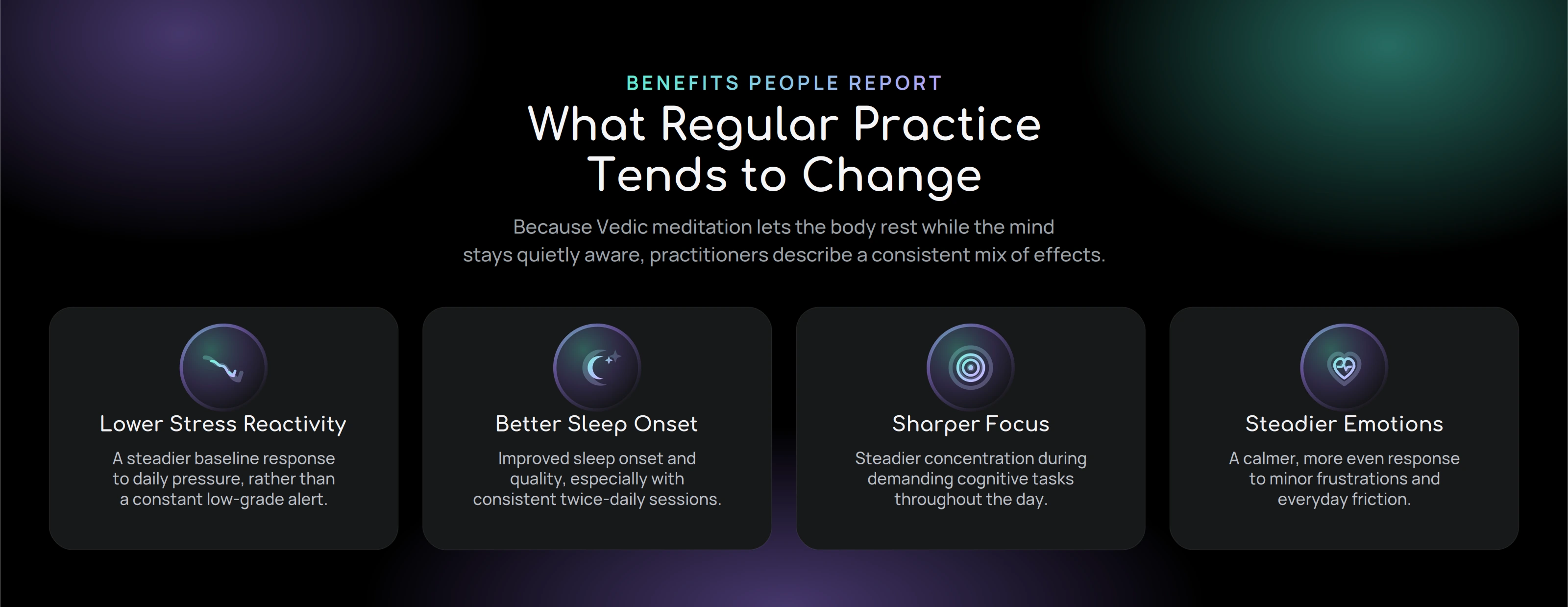
Because Vedic meditation encourages the body toward a genuinely restful state while the mind stays quietly aware, practitioners commonly describe a specific mix of effects:
These outcomes overlap heavily with what's reported from other relaxation-focused practices, including audiovisual meditation. For readers curious about the physiological side of why slowing brainwave activity and reducing sympathetic nervous system arousal produces these effects, Mesmerize's research page breaks down the science behind guided relaxation techniques more broadly.
Committing to a four-day course isn't a small ask, and it's fair to want an easier entry point first. That's where the decision usually comes down to access, budget, and how quickly a person wants results.
For anyone not ready to commit to formal instruction, a short guided session is a reasonable way to build the daily habit muscle first. Mesmerize's 10-minute meditation guide is a practical starting point for that, and it can run alongside — not instead of — a future Vedic course. Consistency, more than technique, tends to be the biggest predictor of whether meditation sticks long-term.
Those already sold on the mantra-based approach should look for teachers with documented certification and a clear lineage, since "Vedic meditation teacher" isn't a formally regulated title everywhere. Ask how the mantra is selected, how long training took, and whether follow-up sessions are included after the initial course.
Vedic meditation earns its reputation the old-fashioned way: through a structured, teacher-led technique that's been refined over generations rather than an app update cycle. It's not the fastest way to start meditating, and it does ask for a real time commitment upfront. But for people drawn to a mantra-based, effortless style of practice, few alternatives offer the same depth of tradition or teaching rigor.
For anyone still deciding where to begin, there's no rule against starting simple. Explore more practical meditation approaches on the Mesmerize wellness blog, compare subscription plans for guided daily sessions, or just download the app and try a short session tonight before deciding whether a deeper, mantra-based path like Vedic meditation is worth pursuing next.
I canceled my subscription with Headspace and I now pay for Mesmerize instead. I was hooked after the free trial! I love how customizable the sounds, meditations, and visuals are! Using this app has honestly become my favorite part of my day! ☺️ It helps me relax, meditate, visualize, sleep, and it does wonders for my anxiety/phobia/ocd tendencies. Thank you Mesmerize for giving us this amazing mental health tool! I told my therapist about this app and have been telling all my friends too. It’s just so helpful!
This is the second or third app in the mindfulness and meditation realm, and it’s the most scientific approach I have found. I have found these combinations of open monitoring, and focused attention meditation techniques are the most viable for those suffering from more severe forms of sleep, pain, and anxiety dysfunction one may be suffering from. Many of these approaches are used by professionals in a cognitive behavioral therapy setting. A truly complete approach in mindfulness and meditation.
I suffer from clinical depression and sometimes I get into a bad headspace but this app has really helped me whenever I’m in a bad mood I turn on the app listen to some person taking about breathing and look at cool figures on my phone and it makes me feel so much better I would highly recommend this app it’s worth the money
It didn’t take but five minutes of using this app to buy a yearly subscription. Worth it on so many levels. Easy to manipulate to what I like. Massive library of music, videos, etc.
Clear your mind and relax with a unique audio visual meditation experience.

.jpeg)