Curious about Ziva meditation? Learn how Emily Fletcher's mindfulness, mantra, and manifesting method works — and whether it fits your routine.
.webp)
Quick Summary: Ziva meditation is a trademarked three-part technique created by Emily Fletcher that blends mindfulness, mantra-based meditation, and manifesting into twice-daily 15-20 minute sessions. It's designed for busy skeptics who want stress relief and mental clarity without years of practice, and it's typically taught through a structured online course. It draws on ancient Vedic mantra traditions but repackages them for a modern, high-performance audience.
Ziva meditation keeps showing up in wellness roundups, celebrity interviews, and endless social feeds — and there's a reason for that staying power. It's one of the few modern meditation brands built specifically for people who think meditation is boring, ineffective, or just not for them. Founder Emily Fletcher designed the whole method around that exact skepticism.
So what actually happens during a Ziva session? And does the manifesting piece hold up on its own, or is it just spiritual dressing on a fairly standard mantra practice? Here's a grounded look at what the technique involves, how sessions are structured, and where it might realistically fit into someone's routine.
Ziva meditation is a three-part technique developed by Emily Fletcher, a former Broadway performer who became a meditation teacher after struggling with insomnia and burnout herself. The method blends mindfulness, a mantra-based meditation practice rooted in Vedic tradition, and a manifesting component that comes after the meditation itself.
The name draws on an old Sanskrit root tied to mantra practice — silently repeating a sound while letting thoughts rise and fall without resistance. Unlike concentration-style meditation, which asks practitioners to focus tightly on the breath or a single point, Ziva goes the other direction entirely. Distraction isn't treated as failure; it's treated as part of the process, a sign that stress is releasing.
Fletcher markets the technique heavily toward entrepreneurs, executives, and "Type-A" personalities — people who want measurable results and aren't interested in years of contemplative practice before feeling anything. That positioning shows up constantly in her book and podcast, and it's a big part of why the brand resonates with people who've bounced off other styles of meditation.
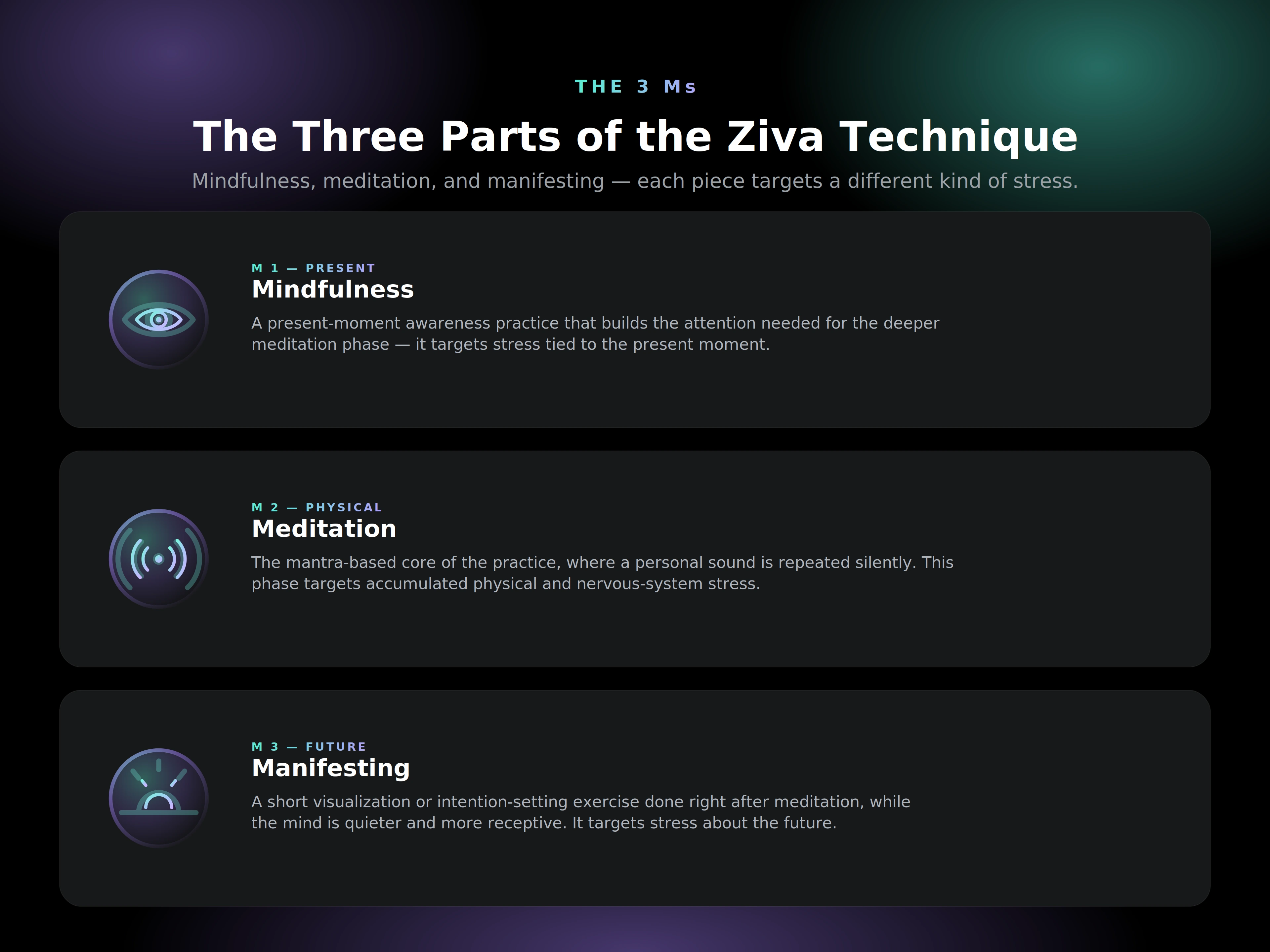
Ziva's structure is often summarized as "the 3 Ms": mindfulness, meditation, and manifesting. Each piece targets a different kind of stress, according to the method's own framing.
A full session generally runs 15 to 20 minutes and is meant to be done twice a day — once in the morning, once in the afternoon or early evening. That's a meaningfully bigger time commitment than a lot of app-based guided sessions, which is one of the more common criticisms of the method.
Ziva Meditation combines meditation techniques with a structured daily practice. Mesmerize can complement that routine with visual breathing, calming soundscapes, guided sessions, and customizable audio.
Mesmerize includes:
👉 Download Mesmerize for iPhone or for Android to try visual meditation for free.
Mantra-based meditation isn't new — Transcendental Meditation (TM) uses a similar mechanism, and both trace back to the same broader Vedic lineage. The main differences tend to show up in accessibility, cost, and framing rather than in the underlying mechanics.
That last row matters for a lot of people who try Ziva and find the twice-daily structure hard to sustain. A shorter, guided 10-minute daily meditation practice can be a more realistic starting point for anyone easing into the habit before committing to a longer mantra routine.
This is where Ziva tends to split opinion. Critics point out that manifesting, as a concept, has no real evidence behind it as a mechanism for changing outcomes in the world. Supporters argue that's not really the point — the value is in the mental clarity that follows meditation, and using that state to clarify goals rather than to conjure them into existence.
Fletcher's newer offering, often marketed as "Ziva Magic," pushes further into embodiment and somatic practice, framing manifestation as something felt in the body through pleasure and nervous-system regulation rather than pure visualization. It's a more advanced, more expensive add-on aimed at people who've already gone through the base course.
Look, the mindfulness and mantra portions of Ziva rest on the same foundation as most evidence-backed meditation research — reduced cortisol, better attention regulation, improved sleep quality. The manifesting layer is harder to substantiate and is best approached as a reflective goal-setting exercise rather than a mystical shortcut.
The flagship course is usually a 15-day online program, delivered through video lessons plus live or recorded coaching calls. Students learn to choose a personal mantra, work through the mindfulness and mantra techniques step by step, and eventually add the manifesting phase once the meditation habit feels stable.
Pricing, course length, and exact curriculum can shift over time, so anyone considering enrollment should check Ziva's official site directly for current details rather than relying on older reviews.
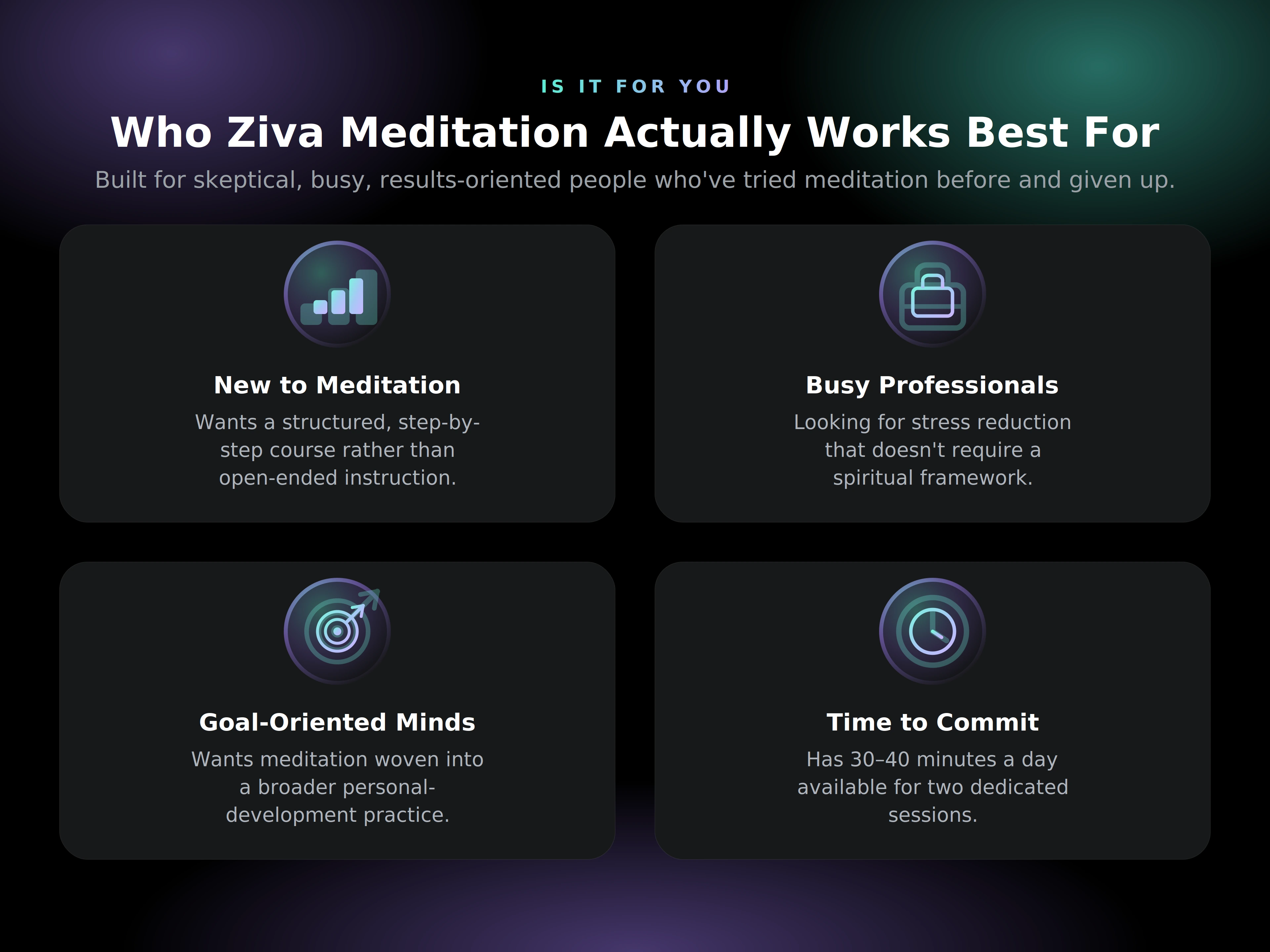
Ziva was built with a specific audience in mind: skeptical, busy, results-oriented people who've tried meditation before and given up. That's a fairly narrow niche, but it's a real one, and the marketing reflects it closely.
It's probably a weaker fit for anyone who wants something ultra-short, free, or app-based — or for people who are uncomfortable with the manifesting framing and just want a straightforward stress-relief practice.
Reported benefits from Ziva practitioners tend to echo what's already well documented for mantra-based and mindfulness meditation generally: lower perceived stress, deeper rest, better focus, and improved sleep over consistent practice. Whether the specific "5x deeper than sleep" style claims made by some Ziva-adjacent marketing hold up under controlled study is a separate question — those figures should be treated as brand messaging rather than settled science.
Common criticisms include the price point relative to free or lower-cost alternatives, the twice-daily time commitment, and the manifesting language that can feel out of step for people who want a purely secular, evidence-first approach.
Whatever technique someone chooses, consistency tends to matter more than the specific method. That's true whether it's a mantra practice, breath-focused mindfulness, or a guided audio-visual session. The research on meditation's effects on stress and attention is broad enough at this point that the science behind visual meditation and other structured approaches both point in a similar direction: regular short sessions beat occasional long ones.
For people who find twice-daily mantra sessions unrealistic, a lighter daily habit — even five or ten minutes — still moves the needle. Apps that use guided visuals and sound rather than silent mantra repetition can lower the barrier to entry considerably, especially for beginners who find silent meditation hard to sustain on their own.
Ziva meditation isn't a magic fix, and it isn't trying to be one — at its core, it's a structured, three-part mantra practice aimed at people who've struggled to make meditation stick. The mindfulness and meditation phases rest on solid, well-researched ground. The manifesting layer is more of a personal development add-on than a proven mechanism, and it's fair to treat it that way.
For anyone weighing whether to commit to a twice-daily, multi-week course, it's worth being honest about time and budget first. Those who want to build a meditation habit with less friction can start smaller — a short guided session most days of the week is a reasonable place to begin. Explore the Mesmerize app for iOS and Android or compare available subscription plans to find a lighter, more flexible way to build consistency before deciding whether a deeper program like Ziva makes sense.
I canceled my subscription with Headspace and I now pay for Mesmerize instead. I was hooked after the free trial! I love how customizable the sounds, meditations, and visuals are! Using this app has honestly become my favorite part of my day! ☺️ It helps me relax, meditate, visualize, sleep, and it does wonders for my anxiety/phobia/ocd tendencies. Thank you Mesmerize for giving us this amazing mental health tool! I told my therapist about this app and have been telling all my friends too. It’s just so helpful!
This is the second or third app in the mindfulness and meditation realm, and it’s the most scientific approach I have found. I have found these combinations of open monitoring, and focused attention meditation techniques are the most viable for those suffering from more severe forms of sleep, pain, and anxiety dysfunction one may be suffering from. Many of these approaches are used by professionals in a cognitive behavioral therapy setting. A truly complete approach in mindfulness and meditation.
I suffer from clinical depression and sometimes I get into a bad headspace but this app has really helped me whenever I’m in a bad mood I turn on the app listen to some person taking about breathing and look at cool figures on my phone and it makes me feel so much better I would highly recommend this app it’s worth the money
It didn’t take but five minutes of using this app to buy a yearly subscription. Worth it on so many levels. Easy to manipulate to what I like. Massive library of music, videos, etc.
Clear your mind and relax with a unique audio visual meditation experience.


.jpeg)