Discover how RAIN meditation eases anxiety and nurtures self-compassion in four simple mindfulness steps popularized by Tara Brach. Start practicing today.
.webp)
Quick Summary: RAIN meditation is a four-step mindfulness practice — Recognize, Allow, Investigate, Nurture — that helps people meet difficult emotions like anxiety with curiosity instead of resistance. Popularized by psychologist Tara Brach, it works by slowing down the automatic reaction to distress and replacing it with awareness and self-compassion. It takes just a few minutes, needs no equipment, and can be practiced anywhere.
Anxiety has a way of showing up uninvited, usually at the worst possible moment. A tight chest before a meeting, racing thoughts at 2 a.m., that low hum of dread that won't name itself. Most people respond to these feelings by pushing them away, arguing with them, or drowning them in distraction. RAIN meditation offers a different move entirely: instead of fighting the feeling, it asks you to turn toward it.
The practice isn't new, but it's had a long run of relevance. Developed and refined by psychologist and meditation teacher Tara Brach, RAIN has become one of the most widely taught tools in modern mindfulness circles — recommended by therapists, used in anxiety workshops, and referenced constantly in self-compassion research. It's simple enough to use in a hallway before a hard conversation, yet deep enough to anchor a full meditation session.
RAIN is an acronym, and each letter marks a distinct step in the process. Here's the breakdown:
That's the whole architecture. No special posture, no incense, no forty-minute time commitment. Just four moves, done in sequence, repeated as often as needed.
The acronym predates Tara Brach's specific version, having circulated in earlier mindfulness and vipassana teaching lineages. But it was Brach who shaped it into the form most people recognize today, adding the Nurture step as an explicit act of self-compassion rather than leaving investigation as the final stage. That addition matters. Without it, RAIN risks becoming another form of clinical self-analysis — noticing a feeling and dissecting it like a lab specimen. With Nurture folded in, the practice closes on warmth instead of analysis.
Brach has taught RAIN extensively through guided audio sessions, workshops, and writing, framing it as a way to "break a trail through the dense forest of anxiety" rather than getting lost in it. The framing has stuck because it matches how anxiety actually feels — tangled, directionless, hard to see through. RAIN doesn't promise to clear the forest. It just offers a path.
.webp)
Start by simply noticing what's happening in this moment. Is there tightness in the chest? A spiral of worried thoughts? A flicker of irritation? The goal here isn't to fix anything yet — just name it, silently or out loud: "This is anxiety." "This is frustration." Naming interrupts the automatic reaction long enough to create a sliver of space.
This is often the hardest step, because most instincts push toward resistance. Allow means letting the feeling exist without trying to shove it away or fix it immediately. It's not approval or resignation — just a pause where the experience is permitted to be present. A common phrase used here is simply "it's okay to feel this."
Now bring gentle curiosity to the sensation. Where does it sit in the body? Does it have a shape, a temperature, a texture? What does this part of you need right now — reassurance, rest, permission to slow down? Investigation isn't interrogation. It's closer to checking in on a friend than cross-examining a suspect.
Finally, offer some form of care. That might be a hand placed over the heart, a soft internal phrase like "you're safe" or "this will pass," or simply the intention to treat yourself the way you'd treat someone you love. This step is what separates RAIN from plain observation — it closes the loop with compassion rather than leaving the feeling examined but unattended.
Many people find it useful to end with a moment of quiet rest, letting the nervous system settle after moving through the sequence. Pairing the practice with slow, ambient visuals or sound can help extend that settling — something explored further on a quick guided meditation session designed for exactly this kind of daily reset.

RAIN meditation moves through recognition, acceptance, investigation, and mindful awareness. Mesmerize can support the practice with guided meditation, visual breathing, calming soundscapes, and relaxing visuals that help create a quieter setting for reflection.
Mesmerize includes:
👉 Download Mesmerize for iPhone or for Android to try visual meditation for free.
Anxiety thrives on avoidance. The more a feeling gets pushed down or argued with, the louder it tends to get — a pattern well documented across cognitive behavioral research on emotional suppression. RAIN interrupts that loop by doing the opposite of avoidance: it invites the feeling in, looks at it directly, and responds with care instead of alarm.
There's also a physiological piece. Naming an emotion (Recognize) engages areas of the brain associated with language and regulation, which tends to quiet the more reactive, threat-focused circuitry. Investigation and Nurture add a layer of self-soothing that can lower physical arousal — slower breath, looser shoulders, a heart rate that stops climbing. None of this requires belief in anything mystical; it's simply what happens when attention shifts from bracing against a feeling to sitting with it.
These aren't competing systems so much as different tools for different moments. Someone in the middle of a panic spike might reach for breathwork first, then use RAIN once the intensity has dropped enough to investigate calmly. Others prefer to open with a slower, visually guided session — the kind offered through Mesmerize's visual meditation app — before layering in RAIN's four steps once the mind has settled a bit.
Tara Brach later expanded the framework into what she calls "the RAIN of self-compassion," shifting emphasis toward how people relate to themselves during suffering rather than just the mechanics of noticing emotion. This version leans harder into the Nurture step, encouraging practitioners to ask directly: "What do I most need to hear right now?"
This matters because a lot of anxious thinking is really self-critical thinking wearing a disguise. "I should be handling this better" or "something's wrong with me for feeling this way" often rides alongside the original anxious feeling, doubling the discomfort. The self-compassion version of RAIN targets that second layer directly, treating harsh self-judgment as its own thing worth recognizing, allowing, investigating, and nurturing.
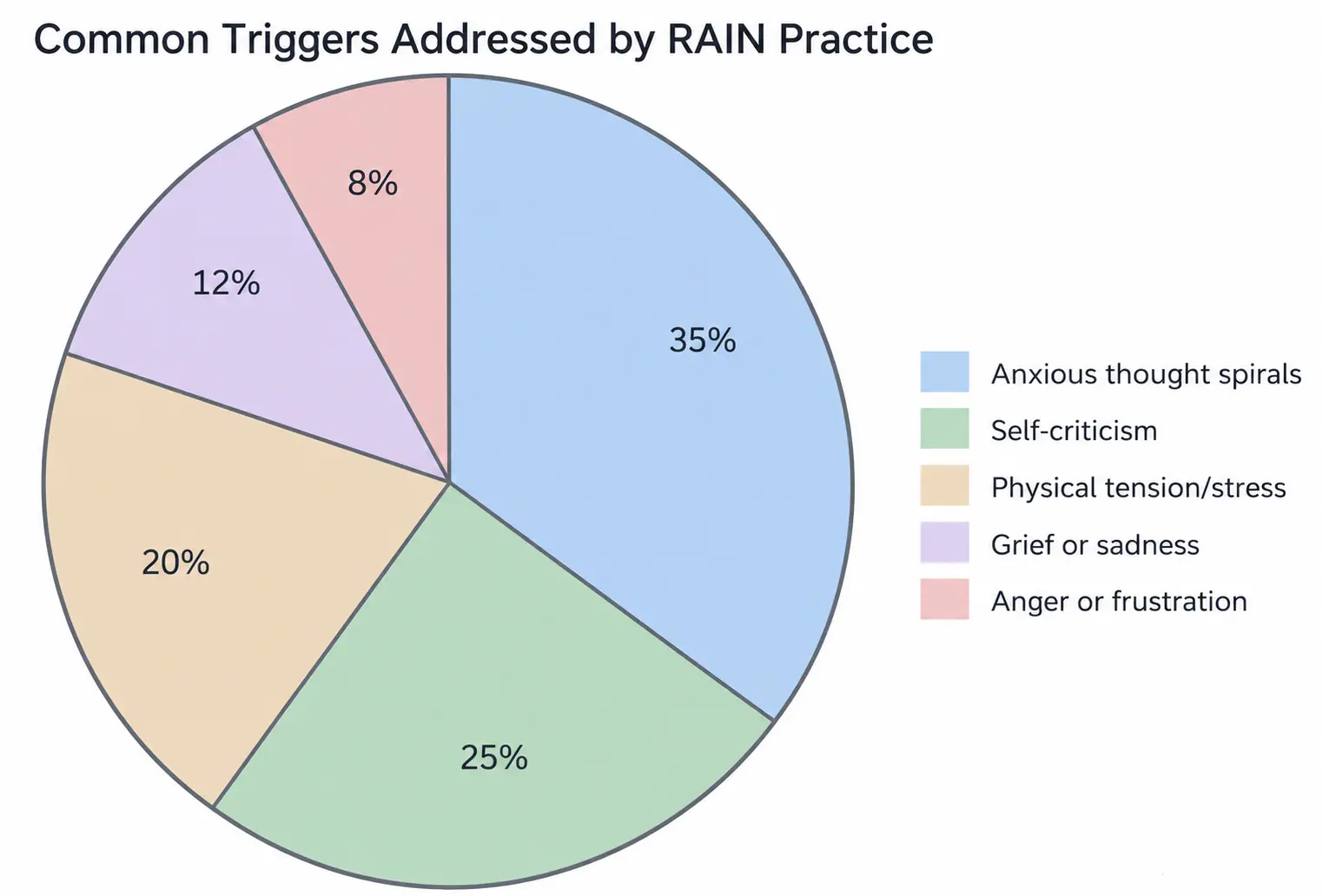
A rough breakdown of the emotional states people commonly bring to a RAIN practice: anxious thought spirals (35%), self-criticism (25%), physical tension or stress (20%), grief or sadness (12%), and anger or frustration (8%).
RAIN doesn't need to be reserved for crisis moments. Some of its value comes from low-stakes repetition — practicing it on mild irritation or minor worry builds the muscle memory needed for when a bigger wave hits. A short daily check-in, even two or three minutes long, tends to work better than an occasional deep dive.
A workable routine might look like this:
For people who find silent sitting difficult, pairing RAIN with a structured audio-visual session can help hold attention steady enough to move through all four steps without drifting. The science behind why visual and ambient input supports this kind of focus is covered in more depth on Mesmerize's research page, which looks at how visual meditation affects attention and relaxation.
A few patterns tend to trip people up early on:
RAIN meditation isn't complicated, and that's exactly why it's stuck around. Four steps, no equipment, and a structure flexible enough to use in a stressful hallway moment or a slow evening wind-down. What it asks for is a bit of willingness — willingness to notice a hard feeling instead of shoving it aside, and willingness to treat yourself with the same kindness offered to a friend.
Anxiety doesn't disappear because of one good technique. But repeated practice with RAIN tends to change the relationship to anxious moments over time, making them feel less like emergencies and more like weather passing through. For those wanting extra support building a consistent habit, pairing the practice with a structured, visually guided routine can make it easier to stay consistent — worth browsing through the full library of meditation guides for ideas on what to try next.
I canceled my subscription with Headspace and I now pay for Mesmerize instead. I was hooked after the free trial! I love how customizable the sounds, meditations, and visuals are! Using this app has honestly become my favorite part of my day! ☺️ It helps me relax, meditate, visualize, sleep, and it does wonders for my anxiety/phobia/ocd tendencies. Thank you Mesmerize for giving us this amazing mental health tool! I told my therapist about this app and have been telling all my friends too. It’s just so helpful!
This is the second or third app in the mindfulness and meditation realm, and it’s the most scientific approach I have found. I have found these combinations of open monitoring, and focused attention meditation techniques are the most viable for those suffering from more severe forms of sleep, pain, and anxiety dysfunction one may be suffering from. Many of these approaches are used by professionals in a cognitive behavioral therapy setting. A truly complete approach in mindfulness and meditation.
I suffer from clinical depression and sometimes I get into a bad headspace but this app has really helped me whenever I’m in a bad mood I turn on the app listen to some person taking about breathing and look at cool figures on my phone and it makes me feel so much better I would highly recommend this app it’s worth the money
It didn’t take but five minutes of using this app to buy a yearly subscription. Worth it on so many levels. Easy to manipulate to what I like. Massive library of music, videos, etc.
Clear your mind and relax with a unique audio visual meditation experience.


.jpeg)