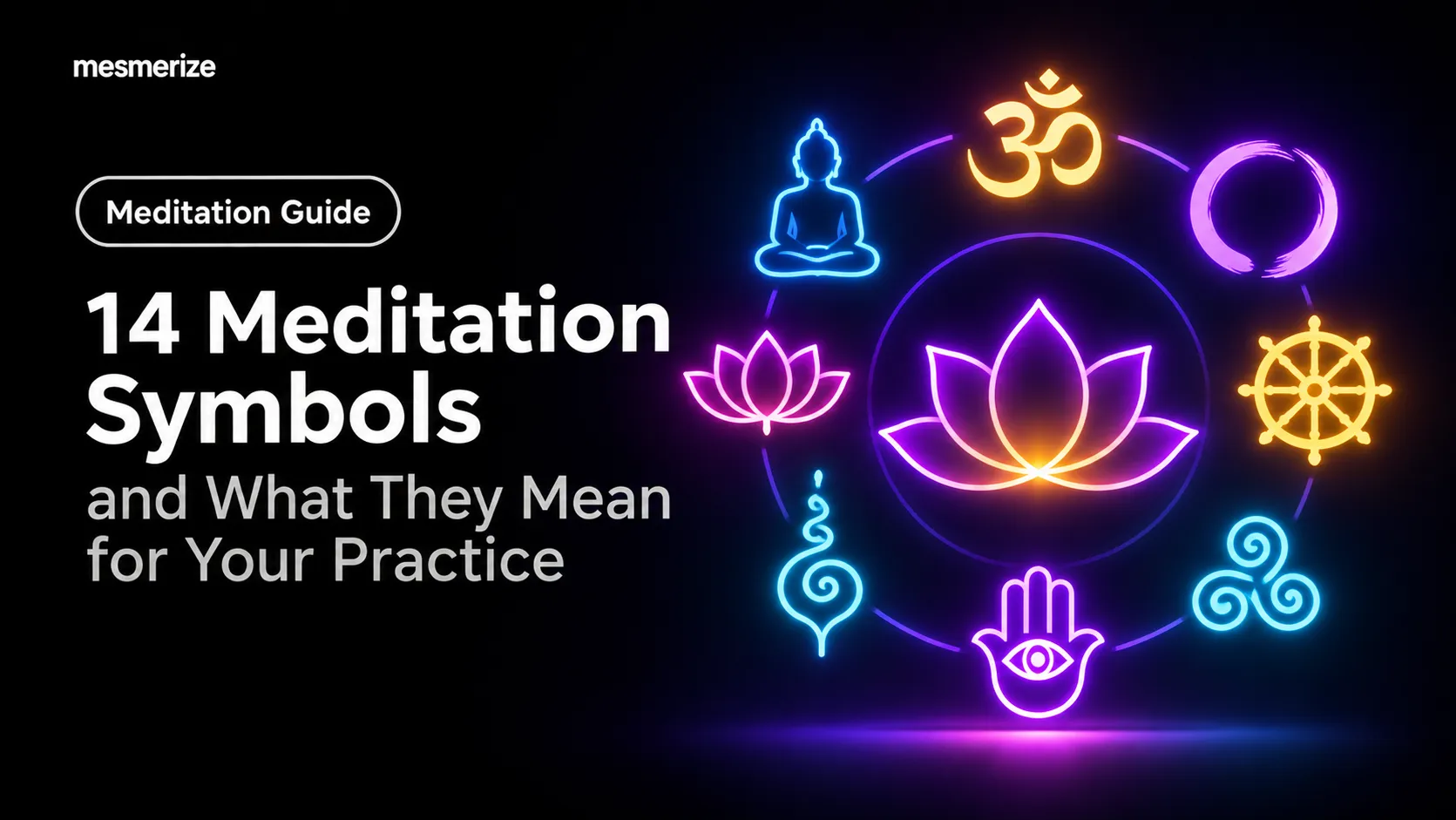
A guide to 14 meditation symbols, from Om and the lotus to the enso, mandala, and unalome, with their meanings, origins, and ways to use them in practice.

Walk into almost any yoga studio or meditation center and you'll see the same images again and again: a curling Om, a lotus flower, a hand-drawn circle, a geometric mandala. These meditation symbols aren't just decoration. Each one carries centuries of meaning, and each can become a focal point that helps the mind settle.
But symbols travel fast in the age of social media, and their original meanings often get lost on the way to a T-shirt or tattoo. This guide explains fourteen of the most common meditation symbols, where they come from, what they represent, and how you can actually use them in your practice with understanding and respect.
A symbol works on two levels at once. Visually, it gives the eyes something simple to rest on, which makes it a natural anchor for focused-attention practice. Mentally, it carries a meaning you can reflect on, like impermanence, compassion, or awakening. That combination of form and meaning is why traditions from Hinduism to Zen use symbols in temples, on altars, and during practice.
Symbols also act as cues. Seeing the same image every time you sit down helps your brain associate it with calm, much like lighting a candle or ringing a bell. Over time, simply glancing at the symbol can start to shift your state. If you're curious how visual focus supports calm more broadly, see our guide to meditation images.
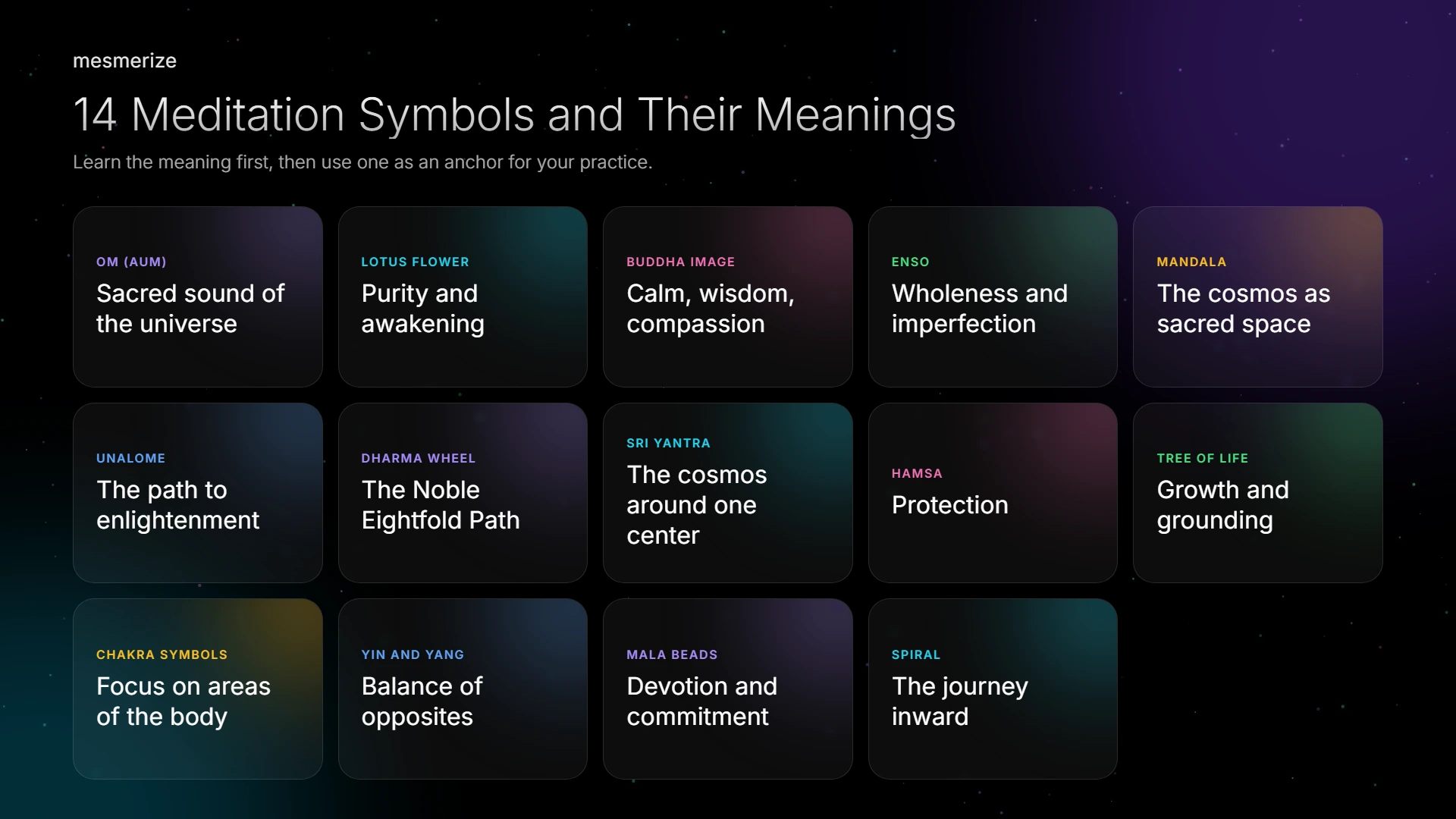
The most widely recognized symbol in Hindu, Buddhist, and Jain traditions. Om is both a written symbol and a sacred sound, often described as the vibration of the universe. Its three curves are traditionally linked to waking, dreaming, and deep sleep, with the dot above representing a fourth state of pure awareness. Om is chanted at the start and end of many practices; see our guide to mantra meditation.
The lotus grows in muddy water yet blooms clean and beautiful above the surface. In Buddhism and Hinduism, it symbolizes purity, spiritual awakening, and the potential to rise above suffering. The seated "lotus position" takes its name from it.
Statues and images of the Buddha serve as reminders of awakening and of the qualities practitioners hope to cultivate: calm, wisdom, and compassion. The hand gestures in these images, called mudras, each carry a specific meaning. Learn more in our guide to the best mudra for meditation.
A circle drawn in a single brushstroke, the enso is central to Zen aesthetics. It can represent enlightenment, emptiness, wholeness, or the beauty of imperfection. Some ensos are closed; others are left open, suggesting that imperfection is part of existence. Drawing an enso is itself a meditative act in Zen. Read more about the tradition in our guide to Zen meditation.
A mandala is a geometric design, usually circular, representing the cosmos or a sacred space. Tibetan monks famously create intricate sand mandalas over days, then sweep them away to illustrate impermanence. Gazing at or coloring a mandala is a popular focus practice.
A spiral that straightens into a line, often ending in dots. The unalome represents the path to enlightenment: the twists of confusion and struggle gradually becoming the straight line of clarity. It's common in Thai Buddhist sacred tattoos.
An eight-spoked wheel representing the Buddha's teaching and the Noble Eightfold Path. It's one of the oldest Buddhist symbols. Our overview of Buddhist meditation explains how the path relates to practice.
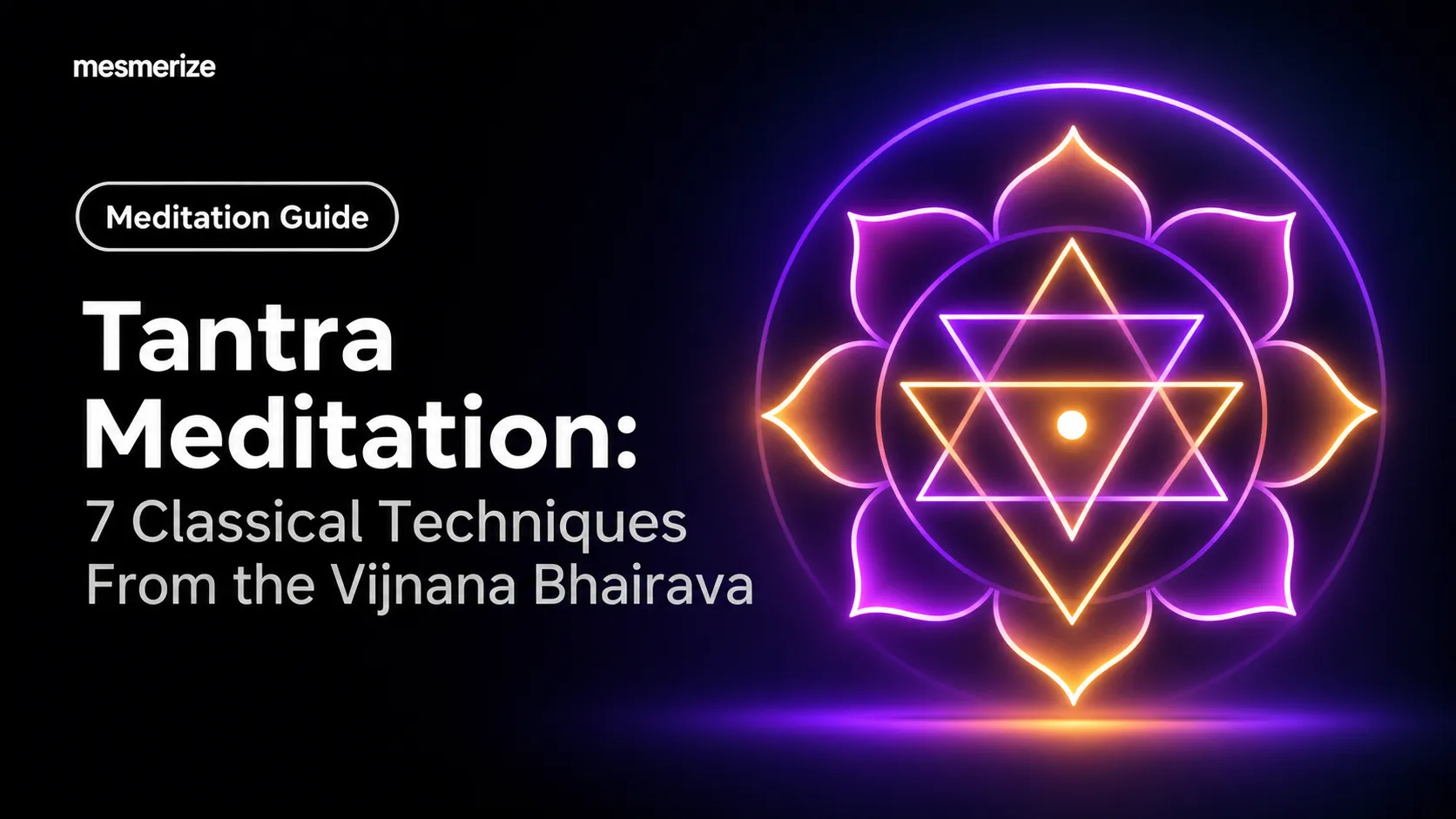
A complex geometric figure of nine interlocking triangles radiating from a central point, called the bindu. In Hindu tantric tradition, it represents the cosmos and the union of masculine and feminine principles. It's used as a visual focus for concentration.
An open palm, often with an eye in the center, found across Middle Eastern and North African cultures and in Jewish and Islamic traditions. It's widely seen as a symbol of protection and is often included in modern meditation spaces as a sign of safety and blessing.
Found in many cultures, the tree of life represents growth, interconnection, and grounding. Roots reaching down and branches reaching up mirror the meditator's balance between earth and sky.
Each of the seven chakras has its own lotus-based symbol, color, and seed sound. They're used to focus attention on different areas of the body in chakra meditation. See our guide to the best chakra meditation.
The Taoist symbol of complementary opposites, dark and light, each containing a seed of the other. It reminds meditators that calm and activity, effort and rest, are parts of one whole.
A string of 108 beads used to count mantras or breaths. Beyond its practical use, the mala symbolizes devotion and commitment to practice. Learn how to use one in our guide to mala meditation.
One of humanity's oldest symbols, carved into ancient stones around the world. In meditation, the spiral often represents the journey inward, growth, and cycles of change.
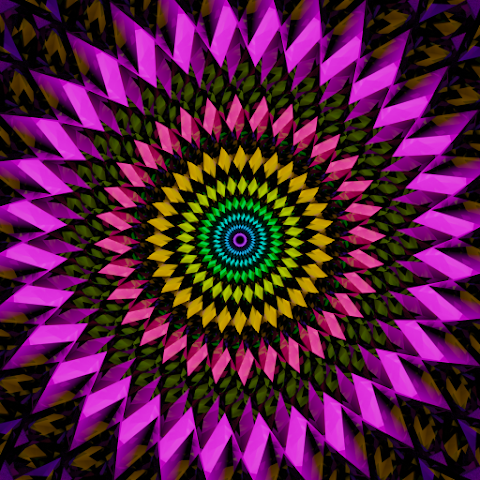
Symbols work because they give your eyes and mind a single, meaningful point to rest on. We built Mesmerize around the same principle. Our flowing visual patterns can feel like living mandalas, giving you an engaging focal point that's easier to stay with than a static image. Pair them with Visual Breathing and the mantra or intention your chosen symbol represents, and you have a complete practice in one place.
Mesmerize gives you:
👉 Download Mesmerize to try visual meditation for free.
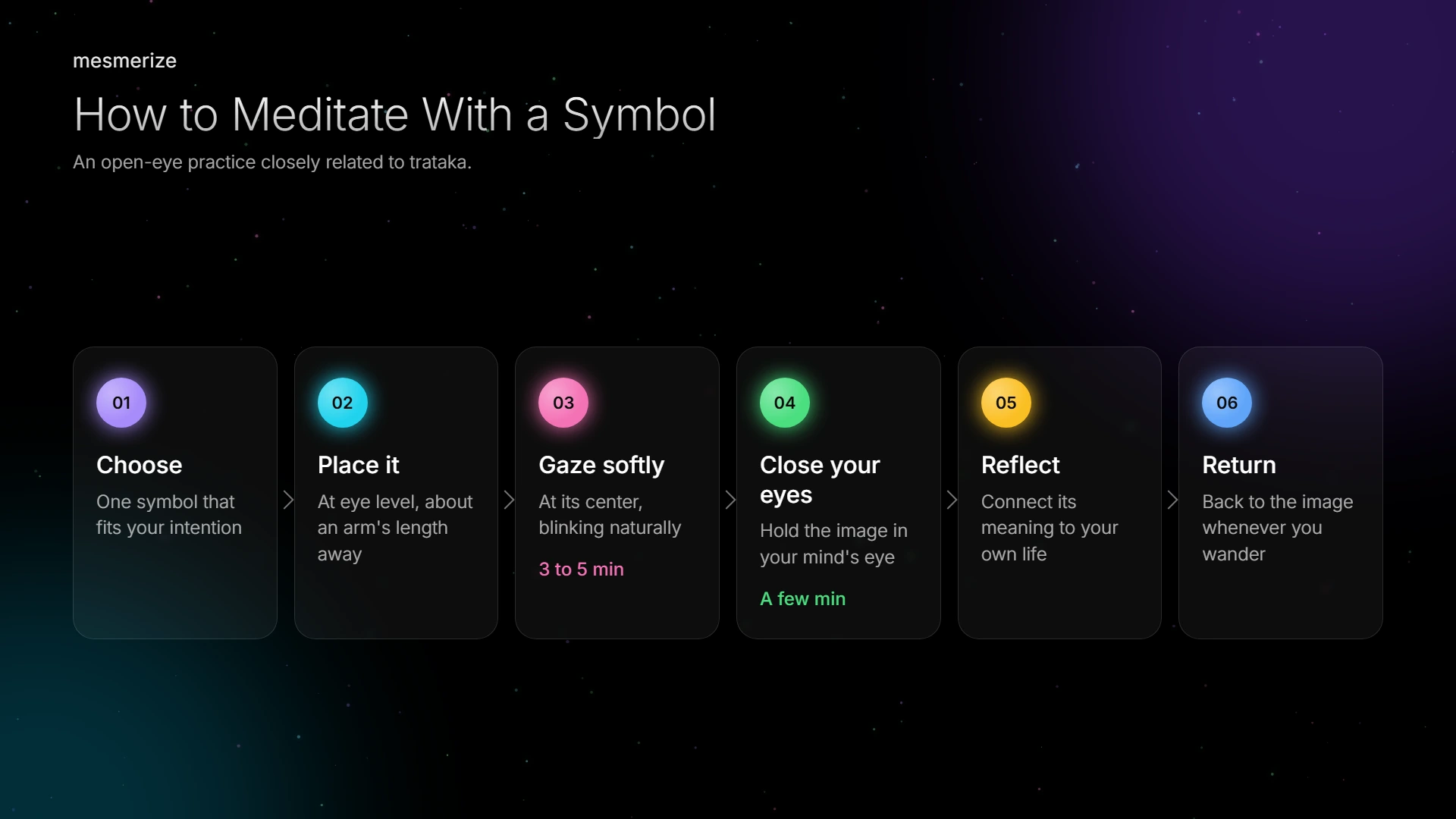
This open-eye technique is closely related to trataka meditation, which traditionally uses a candle flame.
Many meditation symbols are sacred in living religions, and context matters. A Buddha statue placed on the floor, in a bathroom, or used as a garden ornament can offend practicing Buddhists. Om is a holy syllable in Hinduism, and printing it on shoes or doormats is widely considered disrespectful. Thai monks traditionally give unalome tattoos as blessings, and some people feel that getting one purely for fashion strips it of meaning.
None of this means you can't use these symbols if you're not part of the tradition. It means learning their meaning first, placing them in clean, elevated spaces, and choosing them because they genuinely support your practice rather than as trendy decor. A good rule of thumb: treat each symbol the way you'd want a stranger to treat something sacred to you. If you're designing a dedicated corner for practice, our meditation room ideas can help you arrange symbols thoughtfully.
Meditation symbols are more than beautiful designs. Om, the lotus, the enso, mandalas, the unalome, and the others in this guide each carry a meaning that can deepen your practice and a form that can steady your attention. Choose one symbol that matches your current intention, learn its story, and use it as a focal point for a few minutes each day. With understanding and respect, a simple image can become one of your most reliable doorways into calm.
I canceled my subscription with Headspace and I now pay for Mesmerize instead. I was hooked after the free trial! I love how customizable the sounds, meditations, and visuals are! Using this app has honestly become my favorite part of my day! ☺️ It helps me relax, meditate, visualize, sleep, and it does wonders for my anxiety/phobia/ocd tendencies. Thank you Mesmerize for giving us this amazing mental health tool! I told my therapist about this app and have been telling all my friends too. It’s just so helpful!
This is the second or third app in the mindfulness and meditation realm, and it’s the most scientific approach I have found. I have found these combinations of open monitoring, and focused attention meditation techniques are the most viable for those suffering from more severe forms of sleep, pain, and anxiety dysfunction one may be suffering from. Many of these approaches are used by professionals in a cognitive behavioral therapy setting. A truly complete approach in mindfulness and meditation.
I suffer from clinical depression and sometimes I get into a bad headspace but this app has really helped me whenever I’m in a bad mood I turn on the app listen to some person taking about breathing and look at cool figures on my phone and it makes me feel so much better I would highly recommend this app it’s worth the money
It didn’t take but five minutes of using this app to buy a yearly subscription. Worth it on so many levels. Easy to manipulate to what I like. Massive library of music, videos, etc.
Clear your mind and relax with a unique audio visual meditation experience.