Tantra meditation beyond the stereotypes: its roots in the Vijnana Bhairava Tantra, 7 classical solo techniques, a 4-week plan, and common myths explained.

Mention tantra and most people think of sex. That image comes largely from twentieth-century Western "neo-tantra," which focused on intimacy and relationships. Traditional tantra is much broader: a family of Indian spiritual systems, Hindu and Buddhist, that use ritual, mantra, breath, visualization, and attention to sensation as paths to awakening. Sexuality plays a small and often symbolic role in most of these traditions.
One of the richest sources of tantra meditation is a short Sanskrit text called the Vijnana Bhairava Tantra. It contains 112 meditation methods, many of which are simple, solo, and surprisingly modern in feel. This guide introduces the classical side of tantra and walks you through seven techniques you can practice on your own. If you're interested in the partner and intimacy side, see our companion guide to tantric meditation.
The word tantra is often translated as "loom" or "framework," something that weaves practice and understanding together. Tantric traditions emerged in India in the first millennium CE and influenced Hindu, Buddhist, and Jain practice. A central idea in many tantric schools is that ordinary experience, including the body, senses, and emotions, is not an obstacle to awakening but a doorway to it. Instead of withdrawing from sensation, you use it.
That's why tantra meditation often looks different from strict renunciate practices. You might meditate on the pause between breaths, the fading tail of a sound, the vastness of the sky, or the sweetness of a taste. Each becomes a way to notice the awareness that's present in every experience. Practices such as Kundalini meditation and the chakra system also grew from tantric roots. For broader historical context, see our overview of the history of meditation.
The Vijnana Bhairava Tantra is associated with the Kashmir Shaivism tradition and is usually dated to the latter half of the first millennium CE. It's written as a dialogue: the goddess Bhairavi (Devi) asks Shiva (Bhairava) about the nature of reality, and instead of a philosophical answer, he offers 112 practical meditation techniques, called dharanas. Each one is a doorway into the same expansive awareness.
The text reached many Western readers through Centering, a short adaptation by Paul Reps and Lakshmanjoo, later included in the popular collection Zen Flesh, Zen Bones. Its techniques are brief, adaptable, and require no special equipment.
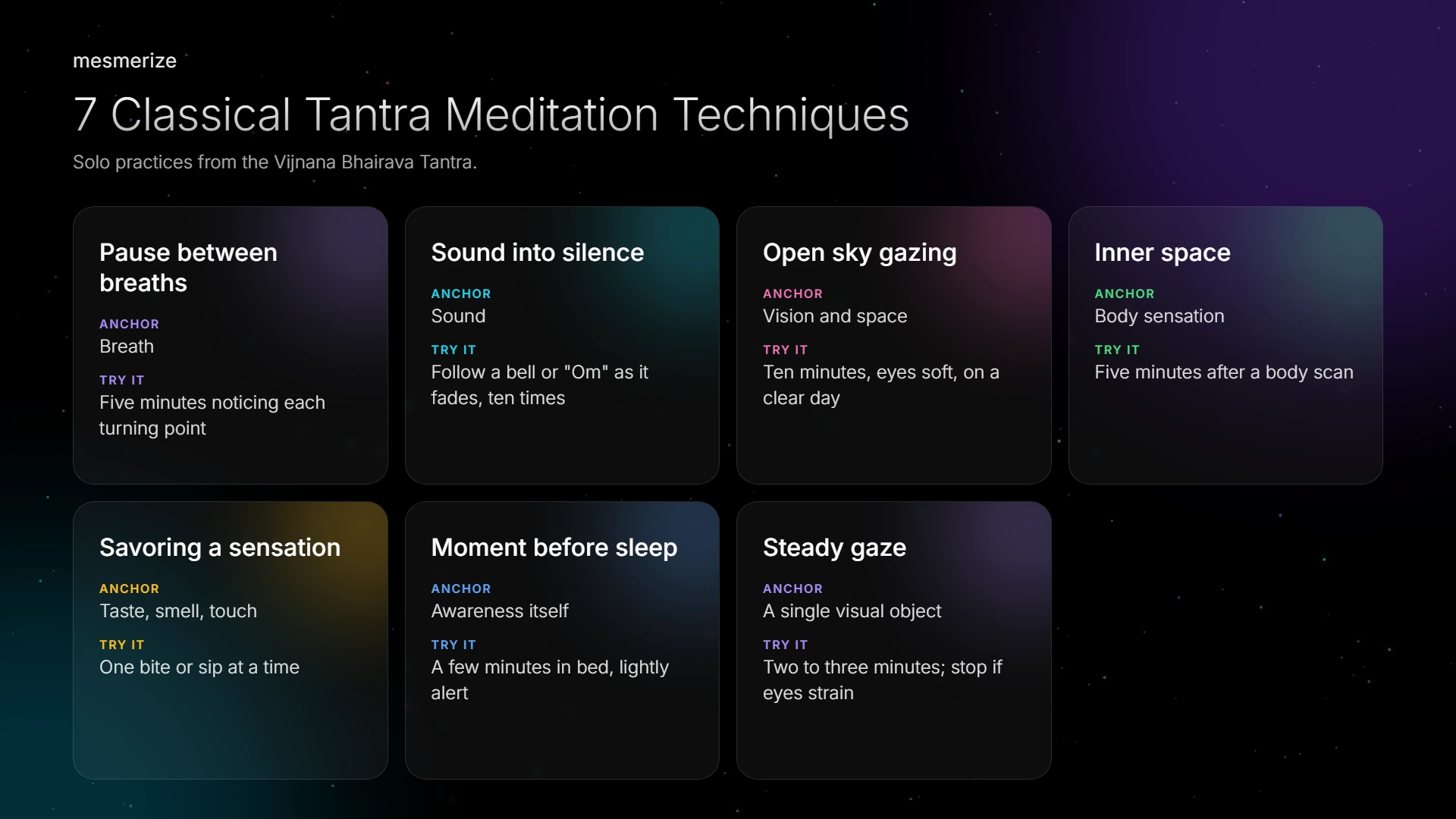
Breathe naturally. Notice the tiny pause after the inhale before the exhale begins, and the pause after the exhale before the next inhale. Rest your attention in those gaps.
Try it: five minutes, counting nothing, just noticing each turning point.
Chant "Om" or strike a bell or singing bowl. Follow the sound as it fades, and keep listening as it disappears into silence. Stay with the silence.
Try it: repeat ten times, resting longer in the silence each time. Our guides to mantra meditation and sound bath meditation explore related practices.
Lie down outdoors or sit by a window and look at a clear sky without focusing on anything. Let the sense of openness fill your awareness.
Try it: ten minutes on a clear day, eyes soft and relaxed.
Close your eyes and imagine the body as hollow, like an empty vessel filled with space. Feel that inner space expand.
Try it: five minutes after a body scan, when the body is already relaxed.
Eat a piece of fruit, sip tea, or smell a flower with complete attention. Let the pleasure of the sensation fill your awareness without judging or grasping it.
Try it: one bite or sip at a time, pausing between each.
As you fall asleep, notice the transition point where waking awareness fades. Stay lightly alert to that edge.
Try it: practice in bed for a few minutes; it's fine if you fall asleep.
Rest your eyes on a single object, like a candle flame or a small dot, without blinking more than necessary, until the mind becomes still. This overlaps with trataka meditation.
Try it: start with two to three minutes, and stop if your eyes strain.

Several of these classical techniques use sight, sound, and breath as doorways, and those are exactly the senses Mesmerize was built around. Rest your gaze on our slowly unfolding visuals as a modern take on the steady gaze technique. Use Visual Breathing to make the pauses between breaths easier to notice, or follow a soundscape until it fades into the silence of our sleep timer.
In Mesmerize, you'll find:
👉 Download Mesmerize to try visual meditation for free.
Classical tantra placed great value on preparation, and a few simple steps make any of these techniques more effective:
Keep a short note after each session: what you noticed, what felt easy, what felt strange. By the end of the month, you'll know which doorways suit you best. For more breath-based options, see our guide to the best breathing techniques for meditation.
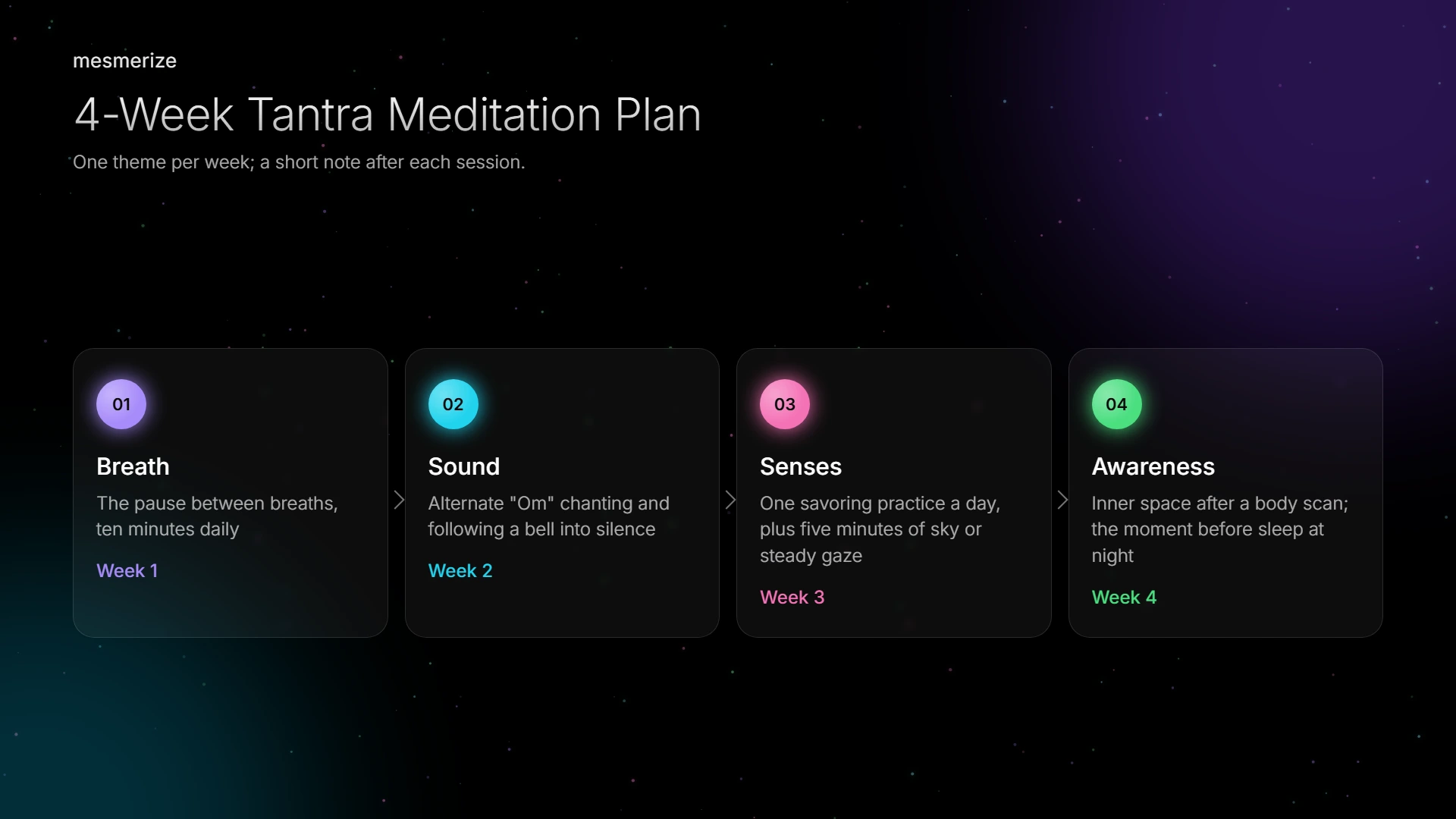
Tantra meditation is far richer than its modern reputation suggests. Rooted in texts like the Vijnana Bhairava Tantra, it uses breath, sound, sight, taste, and the body itself as doorways to a deeper awareness. You don't need a partner, special equipment, or initiation to try the simple techniques in this guide. Start with the pause between breaths, follow the four-week plan, and notice which practices make you feel most awake and present. That sense of awareness running through every experience is what classical tantra is all about.
I canceled my subscription with Headspace and I now pay for Mesmerize instead. I was hooked after the free trial! I love how customizable the sounds, meditations, and visuals are! Using this app has honestly become my favorite part of my day! ☺️ It helps me relax, meditate, visualize, sleep, and it does wonders for my anxiety/phobia/ocd tendencies. Thank you Mesmerize for giving us this amazing mental health tool! I told my therapist about this app and have been telling all my friends too. It’s just so helpful!
This is the second or third app in the mindfulness and meditation realm, and it’s the most scientific approach I have found. I have found these combinations of open monitoring, and focused attention meditation techniques are the most viable for those suffering from more severe forms of sleep, pain, and anxiety dysfunction one may be suffering from. Many of these approaches are used by professionals in a cognitive behavioral therapy setting. A truly complete approach in mindfulness and meditation.
I suffer from clinical depression and sometimes I get into a bad headspace but this app has really helped me whenever I’m in a bad mood I turn on the app listen to some person taking about breathing and look at cool figures on my phone and it makes me feel so much better I would highly recommend this app it’s worth the money
It didn’t take but five minutes of using this app to buy a yearly subscription. Worth it on so many levels. Easy to manipulate to what I like. Massive library of music, videos, etc.
Clear your mind and relax with a unique audio visual meditation experience.