What somatic meditation is, how it differs from mindfulness, core principles like grounding and pendulation, and a 20-minute practice to release tension.

Most meditation instructions start in the head: notice your thoughts, label them, let them go. Somatic meditation starts somewhere else. The word "somatic" comes from the Greek soma, meaning "the living body," and this practice treats the body not as something to ignore while you meditate, but as the doorway to calm.
Instead of trying to think your way out of stress, you feel your way through it: the weight of your body on the chair, warmth in your hands, tightness in your throat, the urge to move. For many people, especially those whose minds race during traditional meditation, this shift is a relief. Here's what somatic meditation is, the principles behind it, and a 20-minute practice you can try today.
Somatic meditation is an umbrella term for meditation practices that center on direct bodily experience. The term is used by several teachers and traditions. Buddhist teacher Reggie Ray, for example, developed a body-centered approach he calls somatic meditation, rooted in Tibetan practice. Others draw on body-oriented therapy, such as Somatic Experiencing, developed by psychologist Peter Levine, which focuses on how stress and trauma are held and released in the nervous system.
What these approaches share is an emphasis on interoception, the ability to sense internal signals like heartbeat, breath, muscle tension, hunger, and emotion as physical sensation. Research suggests interoceptive awareness is closely tied to emotional regulation, which helps explain why tuning into the body can make difficult feelings more manageable.
The two overlap a lot. A classic body scan is both mindful and somatic. The difference is mainly emphasis and pacing.
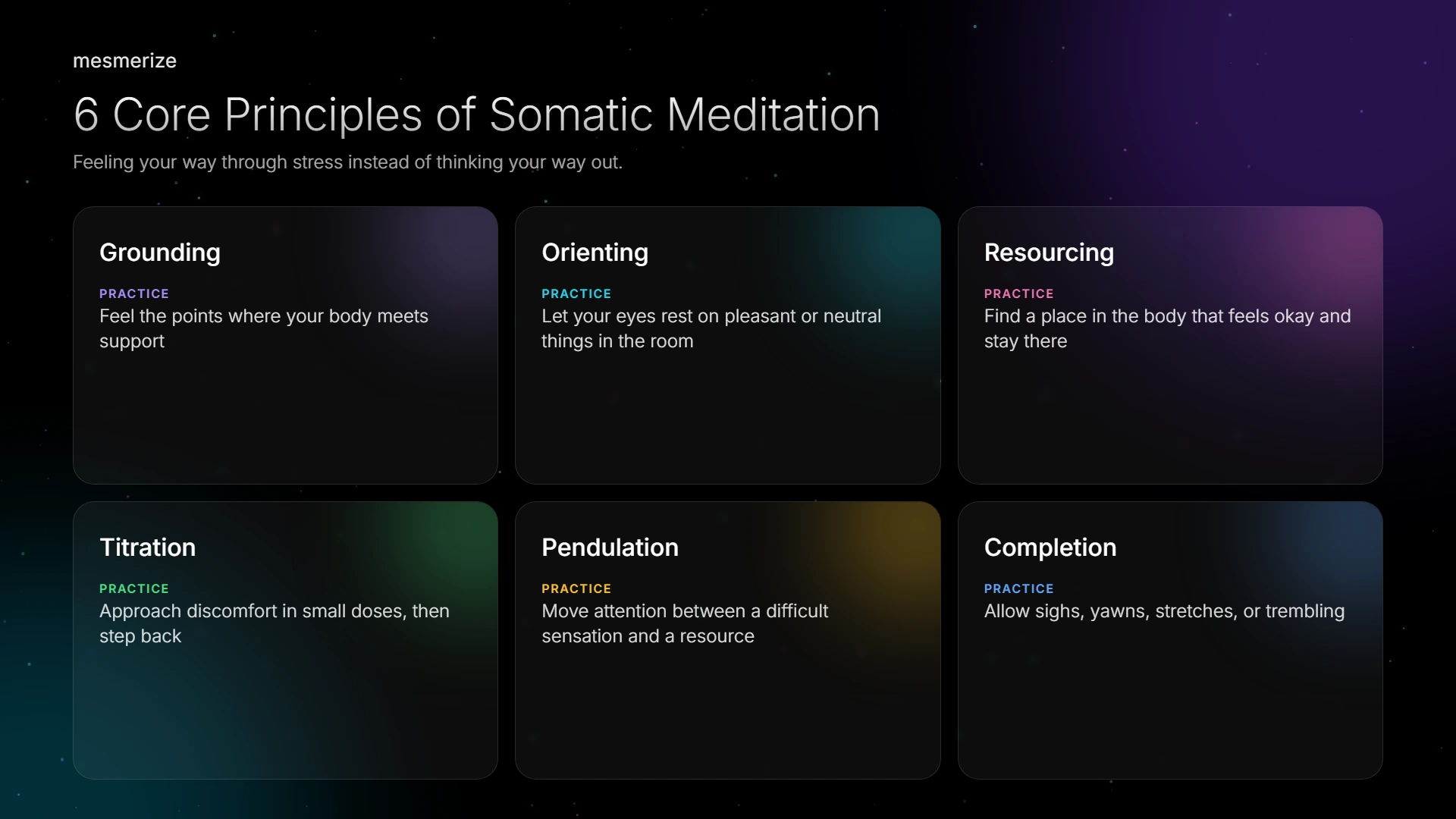
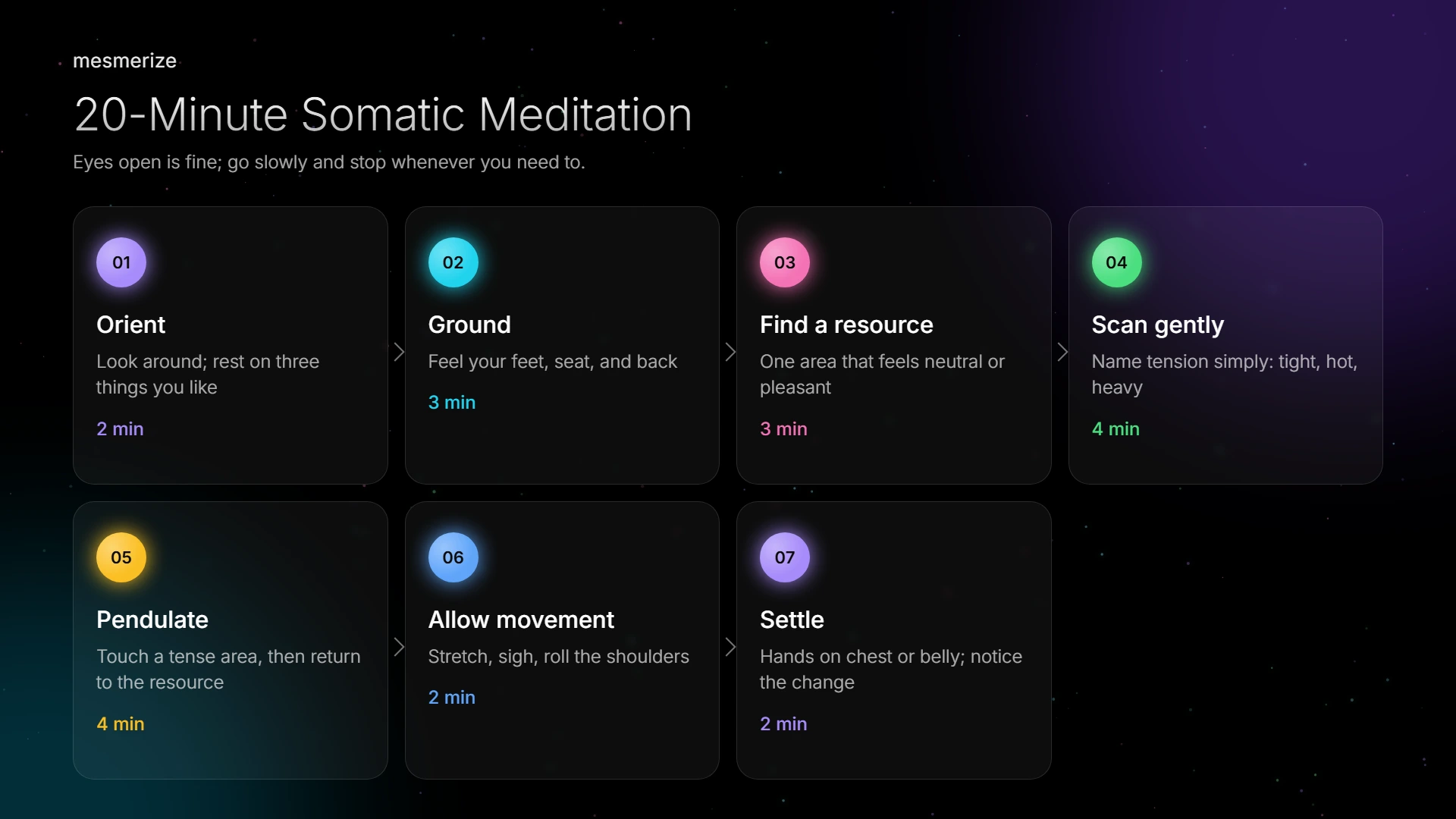
Feel the points where your body meets support: feet on the floor, sitting bones on the chair, back against the wall. Grounding gives the nervous system a clear signal of stability. Explore it further in our guide to grounding meditation.
Let your eyes slowly look around the room, resting on colors, shapes, and objects that feel pleasant or neutral. Orienting is a natural animal behavior that tells the brain, "I'm safe here."
Find a place in the body that feels okay or even pleasant, like warm hands or a relaxed belly, and spend time there. This "resource" becomes a home base you can return to.
Approach discomfort in small doses. Instead of diving into the most intense sensation, touch the edge of it briefly, then step back.
Move attention back and forth between a difficult sensation and a resource. This rhythm, a term used in Somatic Experiencing, helps the body discharge tension without becoming overwhelmed.
Allow natural movements like sighing, yawning, stretching, or trembling. These are often signs that the body is releasing stored activation.

Somatic practice works best when the environment feels safe, slow, and steady. We designed Mesmerize to create exactly that. Keep your eyes open on our gentle visuals for an easy orienting point, or follow Visual Breathing while you scan your body for sensation. When tension shows up as physical pain, our pain relief sessions combine relaxation, soothing narration, and soundscapes to help your body let go.
Inside Mesmerize, you'll find:
👉 Download Mesmerize to try visual meditation for free.
If sitting still is hard, try a moving version with our guide to walking meditation. For lying-down rest after the practice, yoga nidra is a wonderful complement.
Somatic awareness grows fastest when you sprinkle it through the day, not just during formal sessions:
These tiny moments teach the nervous system that it's safe to notice sensation, which makes longer practice easier.
Somatic meditation can bring up strong emotions, especially if you carry unresolved trauma. Shaking, tears, or sudden memories are not signs you're doing it wrong, but they can be a sign that you'd benefit from a guide. Trauma-informed therapists trained in body-based methods can help you work at a pace your nervous system can handle. Our article on the best meditation for trauma explains gentler starting points.
It's also wise to check with a doctor if physical symptoms like chronic pain, dizziness, or a racing heart are part of what you're working with. Somatic practices can support recovery, but they don't replace medical care. For pain specifically, see our guide to meditation for pain relief. And if anxiety is your main concern, you'll find more tools in our guide to meditation for anxiety.
Somatic meditation shifts the focus of practice from the mind to the body. By grounding, orienting, finding resources, and moving slowly between comfort and discomfort, you give your nervous system the chance to settle and release tension it may have held for a long time. Start with the 20-minute practice above, go at your own pace, and let movement and sighs happen naturally. Over time, many people find that listening to the body is the most direct path to feeling calm.
I canceled my subscription with Headspace and I now pay for Mesmerize instead. I was hooked after the free trial! I love how customizable the sounds, meditations, and visuals are! Using this app has honestly become my favorite part of my day! ☺️ It helps me relax, meditate, visualize, sleep, and it does wonders for my anxiety/phobia/ocd tendencies. Thank you Mesmerize for giving us this amazing mental health tool! I told my therapist about this app and have been telling all my friends too. It’s just so helpful!
This is the second or third app in the mindfulness and meditation realm, and it’s the most scientific approach I have found. I have found these combinations of open monitoring, and focused attention meditation techniques are the most viable for those suffering from more severe forms of sleep, pain, and anxiety dysfunction one may be suffering from. Many of these approaches are used by professionals in a cognitive behavioral therapy setting. A truly complete approach in mindfulness and meditation.
I suffer from clinical depression and sometimes I get into a bad headspace but this app has really helped me whenever I’m in a bad mood I turn on the app listen to some person taking about breathing and look at cool figures on my phone and it makes me feel so much better I would highly recommend this app it’s worth the money
It didn’t take but five minutes of using this app to buy a yearly subscription. Worth it on so many levels. Easy to manipulate to what I like. Massive library of music, videos, etc.
Clear your mind and relax with a unique audio visual meditation experience.