What inner child meditation is, where the idea comes from, signs your inner child needs care, a 20-minute practice, and journaling and reparenting exercises.

Sometimes a small moment produces a huge reaction. A partner forgets to text back and you feel abandoned. A boss gives neutral feedback and you feel like a failure. A friend cancels plans and you're suddenly ten years old again, waiting by the window. Many therapists describe these moments as your "inner child" speaking: the part of you that still carries the feelings, needs, and beliefs you formed early in life.
Inner child meditation is a gentle practice for meeting that younger part of yourself with the kindness, safety, and attention it may not always have received. It combines visualization, self-compassion, and compassionate self-talk. Below you'll learn where the concept comes from, how to tell your inner child needs care, a step-by-step guided practice, and simple exercises to continue the work.
The "inner child" is a metaphor, not a separate personality. It describes the emotional patterns, memories, and core beliefs formed in childhood that continue to shape how we feel and react as adults. Psychiatrist Carl Jung wrote about a "child archetype" representing both vulnerability and potential. The idea became popular in self-help through authors such as John Bradshaw, whose 1990 book Homecoming encouraged readers to "reclaim" their wounded inner child, and art therapist Lucia Capacchione, who developed creative exercises like writing with the non-dominant hand.
Modern therapies use related ideas. Schema therapy, for example, works with "modes," including a vulnerable child mode, and Internal Family Systems therapy speaks of younger "parts" carrying old burdens. Inner child meditation borrows from this landscape in a simpler, self-guided form. It's best understood as a structured way to practice self-compassion toward your younger self.
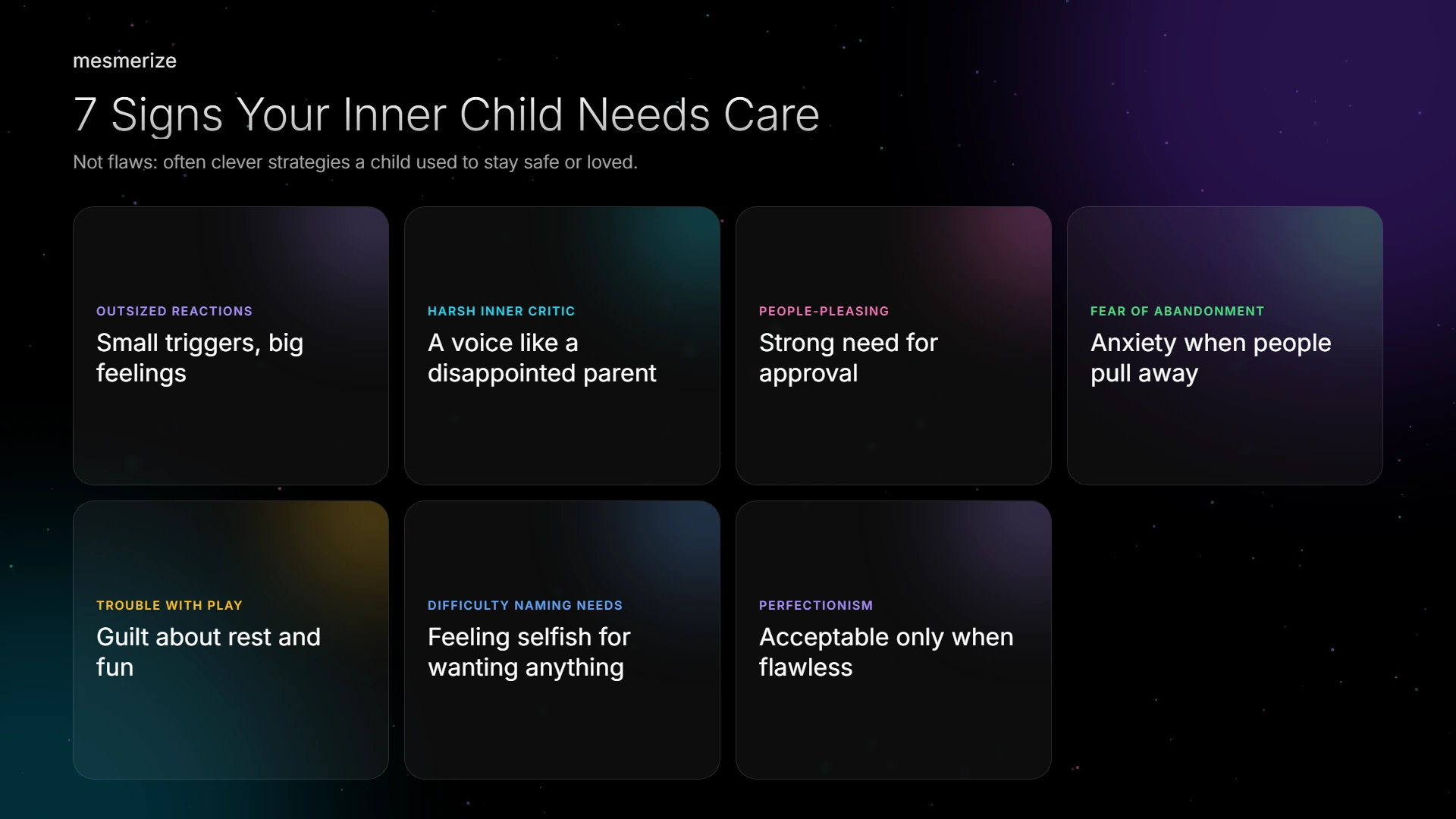
These patterns aren't flaws. They're often clever strategies a child used to stay safe or loved, still running long after the original situation has changed.
Sit or lie somewhere comfortable and safe. Have a blanket nearby, since warmth can help. Close your eyes or soften your gaze. Take several slow breaths, letting your exhales grow longer. Place a hand on your chest or belly.
If emotions come up, that's normal. Let tears flow if they want to. If anything feels overwhelming, open your eyes, ground yourself, and stop. Our guide to grounding meditation can help.

Inner child work asks you to feel safe enough to be vulnerable, and that's hard when your body is tense. We designed Mesmerize to help create that safety first. A few minutes of Visual Breathing calms your nervous system before you begin, and our soothing soundscapes or nature sounds can hold the space while you visualize. On harder days, our anxiety relief sessions and narrated affirmations offer the kind of calm, kind voice your younger self might need.
With Mesmerize, we offer:
👉 Download Mesmerize to try visual meditation for free.
Write a letter to yourself at a specific age. Tell them what you know now, what you're proud of, and what you wish someone had said to them.
Inspired by Lucia Capacchione, write a question with your dominant hand ("How are you feeling?") and answer with your non-dominant hand. The awkward, childlike handwriting can make it easier to access simple, honest feelings.
Do something you loved as a child: draw, build with blocks, swing at a park, dance in the kitchen. Notice what comes up without judging it.
Look at a childhood photo for a few minutes and offer that child kind words, as you would to any child you love.
Choose one phrase to repeat daily, especially when old patterns show up: "I've got you." "Mistakes are how we learn." "Your feelings make sense." This mirrors the kindness practice in our guide to metta meditation.
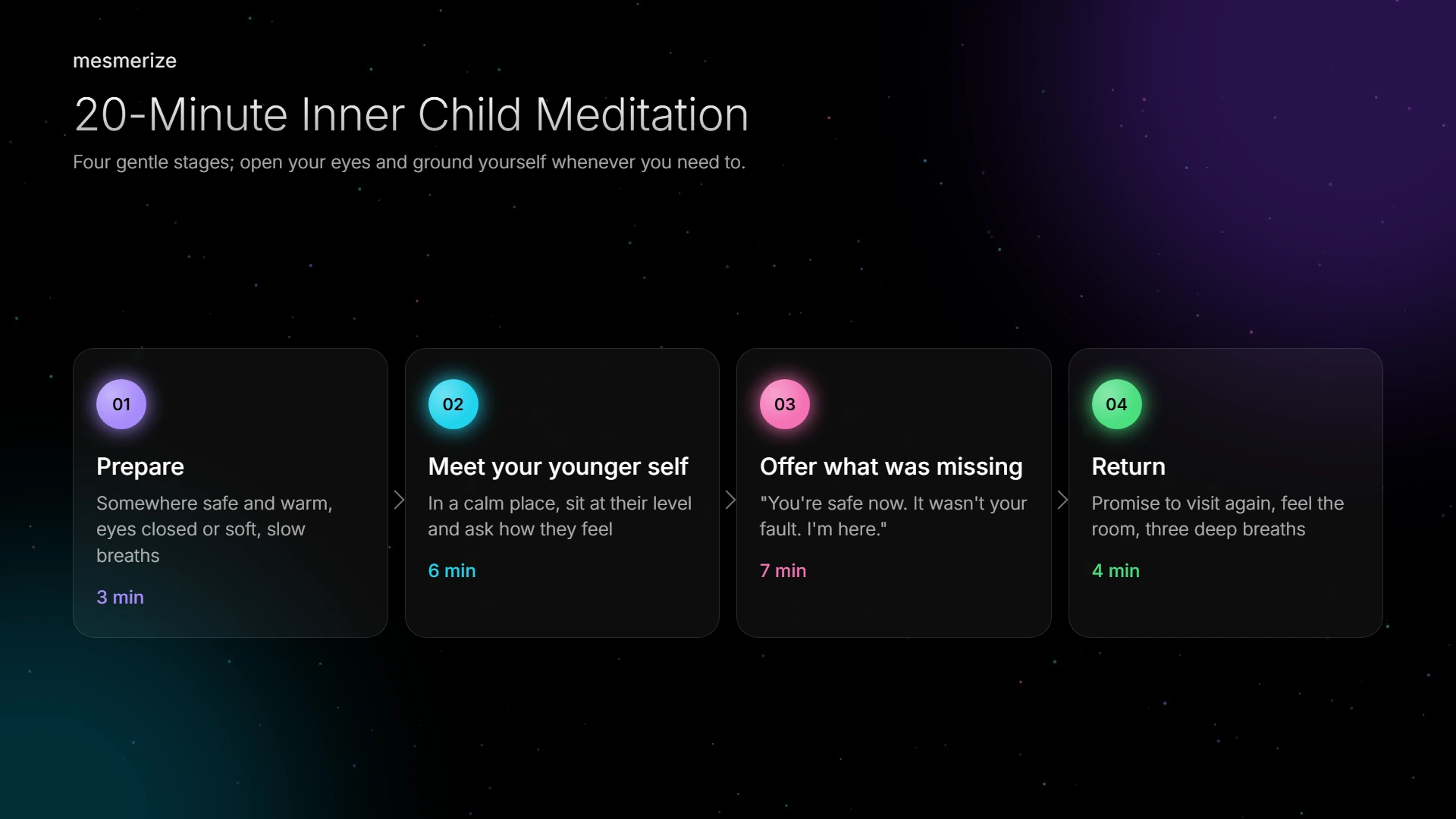
You don't need to guess perfectly. Try a phrase and notice whether something in your body softens. That softening is a sign you've offered what was needed.
For many people, inner child meditation is a warm, healing experience. For others, especially those with a history of abuse, neglect, or significant trauma, revisiting childhood can open painful memories quickly. That doesn't mean you should avoid the work, but it does mean going slowly and having support. A trauma-informed therapist can guide you through these experiences at a pace your nervous system can handle and help you make sense of what emerges.
It's also worth remembering that the goal is not to relive the past but to offer your younger self something new in the present. If a session leaves you feeling worse rather than lighter, try shorter visits, focus on safe and happy memories first, or switch to gentler practices like healing meditation and gratitude meditation. Our article on the best meditation for trauma offers more trauma-sensitive approaches, and if you're also managing low mood or worry, see meditation for anxiety and depression.
Inner child meditation is a way of becoming the caring adult your younger self needed. By visualizing a safe meeting, listening to what that child feels, and offering words of safety and acceptance, you practice self-compassion in one of its most personal forms. Combine short meditations with letters, play, and daily reparenting phrases, go gently, and seek support if painful memories arise. Over time, many people find that their reactions soften and their inner critic becomes a little kinder.
I canceled my subscription with Headspace and I now pay for Mesmerize instead. I was hooked after the free trial! I love how customizable the sounds, meditations, and visuals are! Using this app has honestly become my favorite part of my day! ☺️ It helps me relax, meditate, visualize, sleep, and it does wonders for my anxiety/phobia/ocd tendencies. Thank you Mesmerize for giving us this amazing mental health tool! I told my therapist about this app and have been telling all my friends too. It’s just so helpful!
This is the second or third app in the mindfulness and meditation realm, and it’s the most scientific approach I have found. I have found these combinations of open monitoring, and focused attention meditation techniques are the most viable for those suffering from more severe forms of sleep, pain, and anxiety dysfunction one may be suffering from. Many of these approaches are used by professionals in a cognitive behavioral therapy setting. A truly complete approach in mindfulness and meditation.
I suffer from clinical depression and sometimes I get into a bad headspace but this app has really helped me whenever I’m in a bad mood I turn on the app listen to some person taking about breathing and look at cool figures on my phone and it makes me feel so much better I would highly recommend this app it’s worth the money
It didn’t take but five minutes of using this app to buy a yearly subscription. Worth it on so many levels. Easy to manipulate to what I like. Massive library of music, videos, etc.
Clear your mind and relax with a unique audio visual meditation experience.